
Clkklpm 3D Magic Popcorn Pens Review: Faulty Heat-Activated Art
By AValidReview. An AI-assisted summary of customer feedback, not a hands-on test.
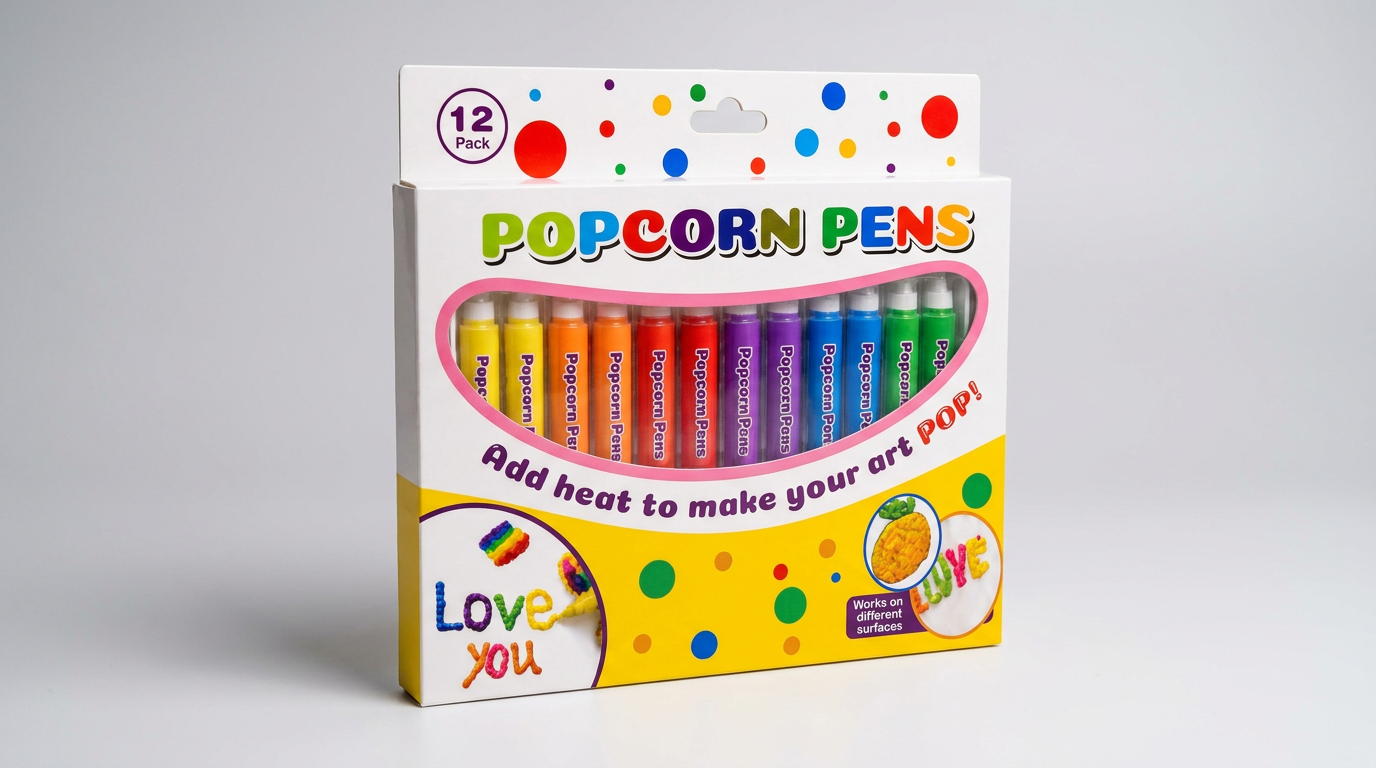
The Clkklpm 3D Magic Popcorn Pens sit at the center of an additive illusion: marketing that borrows the language of dimensional fabrication while delivering ordinary chemical expansion paint. Frequently indexed in digital storefronts alongside genuine thermoplastic 3D pens, these liquid markers promise instant tactile relief for paper crafts. In practice, they substitute digital precision with an unpredictable thermal reaction that requires external heat sources, delicate manual timing, and considerable patience.
The core problem is what we call the thermal activation chasm. Between wet ink and expanded foam lies a narrow margin of heat and air velocity that domestic hair dryers struggle to deliver reliably. Instead of a spontaneous creative tool for children, buyers receive a finicky multi-stage chemical craft kit that demands strict adult intervention just to avoid ruining a workspace.
While a successful application yields an undeniably charming puffy relief on paper, the journey to get there is fraught with failure points. From blocked nozzles and internal pressure mismatches to liquid paint splattering across surfaces, this set highlights the gap between novelty marketing and tabletop reality.
What owners love
- + Bright assortment of 12 distinct colors for craft projects
- + Generates genuine dimensional texture when the thermal balance is right
- + Fine-tip attachments allow reasonable line-drawing accuracy
- + Engaging tactile result for poster boards and handmade cards
Common complaints
- − High failure rate with paint frequently remaining flat and oily
- − Hair dryer airflow easily splatters wet pigment across rooms
- − Cumbersome multi-step preparation requires constant adult oversight
- − Narrow thermal window between adequate foaming and scorched paper
Design & Build
The Clkklpm kit arrives as a series of small squeeze bottles paired with interchangeable precision tips. Rather than a ready-to-draw marker, each tube utilizes a dual-closure system featuring an outer screw cap and an internal protective stopper. The plastic used for the reservoirs is relatively stiff, which makes regulating flow rate difficult for smaller hands. Squeezing too hard yields an uneven surge of emulsion, while gentle pressure often produces thin, broken lines. The precision nozzles thread directly onto the neck once the stopper is removed, but tolerances are loose, leading to occasional seepage around the collar during active use.
Setup & Ease of Use
Operating these pens carries a heavy process friction tax. To begin, an adult must uncap the tube, pry out the inner plug without spilling pigment, and seat the applicator tip tightly. Once artwork is down on paper, users cannot simply apply heat immediately. The manufacturer advises letting the lines settle briefly so surface tension can take hold, yet leaving them too long causes the active foaming agents to cure prematurely. This intermediate waiting stage clashes directly with how children engage with art supplies, turning an activity meant to be spontaneous into a disciplined laboratory procedure.
Performance in Real Use
Actual output hinges entirely on managing the thermal activation chasm. To achieve the popcorn effect, users must pass a high-heat, low-velocity heat source over the artwork. In real homes, this means a standard hair dryer. If the dryer pushes too much air, the wet emulsion scatters instantly, leading to ruined projects and paint sprayed onto nearby walls or kitchen counters. Conversely, if the heat is insufficient or held too far away, the reaction never triggers. Owners frequently find that designs simply bake into a greasy, flat film that resembles stale oil paint rather than raising into tactile foam.
Software & Ecosystem
While these pens reside in catalog categories meant for additive manufacturing hardware, they have zero electronic or software components. The ecosystem here is strictly environmental: your choice of paper stock, your hair dryer, and your work surface. Standard copy paper buckles severely under the moisture of the paint and the subsequent heat blast, meaning successful projects require heavyweight cardstock or poster board. Because no specialized heating attachment is included in the box, users must experiment blindly with their own bathroom appliances to find an airflow setting that will not turn the wet craft into airborne splatter.
Value & Reliability
Priced in the $15 to $25 range, the 12-piece Clkklpm set competes against both traditional fabric puff paints and entry-level children's 3D filament pens. Its value proposition collapses under its low consistency. When multiple pens in a set either fail to expand or deposit pigment that cures flat, the cost per successful drawing rises dramatically. Given that several owners report throwing the entire package away after their first disastrous session, the set represents a poor return on investment compared to standard dimensional craft paints that cure reliably at room temperature.
Verdict
Stay Away - Severe mechanical and thermal unreliability turns what should be a playful craft project into a messy, frustrating chore.
This kit is viable only for dedicated adult crafters who possess a dedicated variable-speed craft heat gun and the patience to test viscosity on scrap stock before committing to real projects. It is completely unsuitable for independent child use, quick classroom activities, or casual weekend crafting.
What buyers miss is that the product relies on category confusion. By presenting heat-reactive emulsion as a magical 3D tool, Clkklpm sells a temperamental chemical reaction masquerading as an intuitive craft pen. Unless you relish scrubbing blown pigment off kitchen counters, standard dimensional craft paint remains the far smarter purchase.
FAQ
More 3D Printing Pens reviews
Topacme 3D Relief Art Pen Review: Magic Popcorn Pens Tested
Barods Popcorn Pens Review: Novelty Craft Failure
LTGEM 3D Printing Pen Hard Case Review
co2CREA Storage Case for 3D Printing Pen Review
Lebakort Storage Case for 3Doodler Start+ Review
SCRIB3D Advanced 3D Printing Pen Review: Beyond the Hobbyist
This review is based on real experiences shared by owners in online communities.