
Barods Popcorn Pens Review: Novelty Craft Failure
By AValidReview. An AI-assisted summary of customer feedback, not a hands-on test.
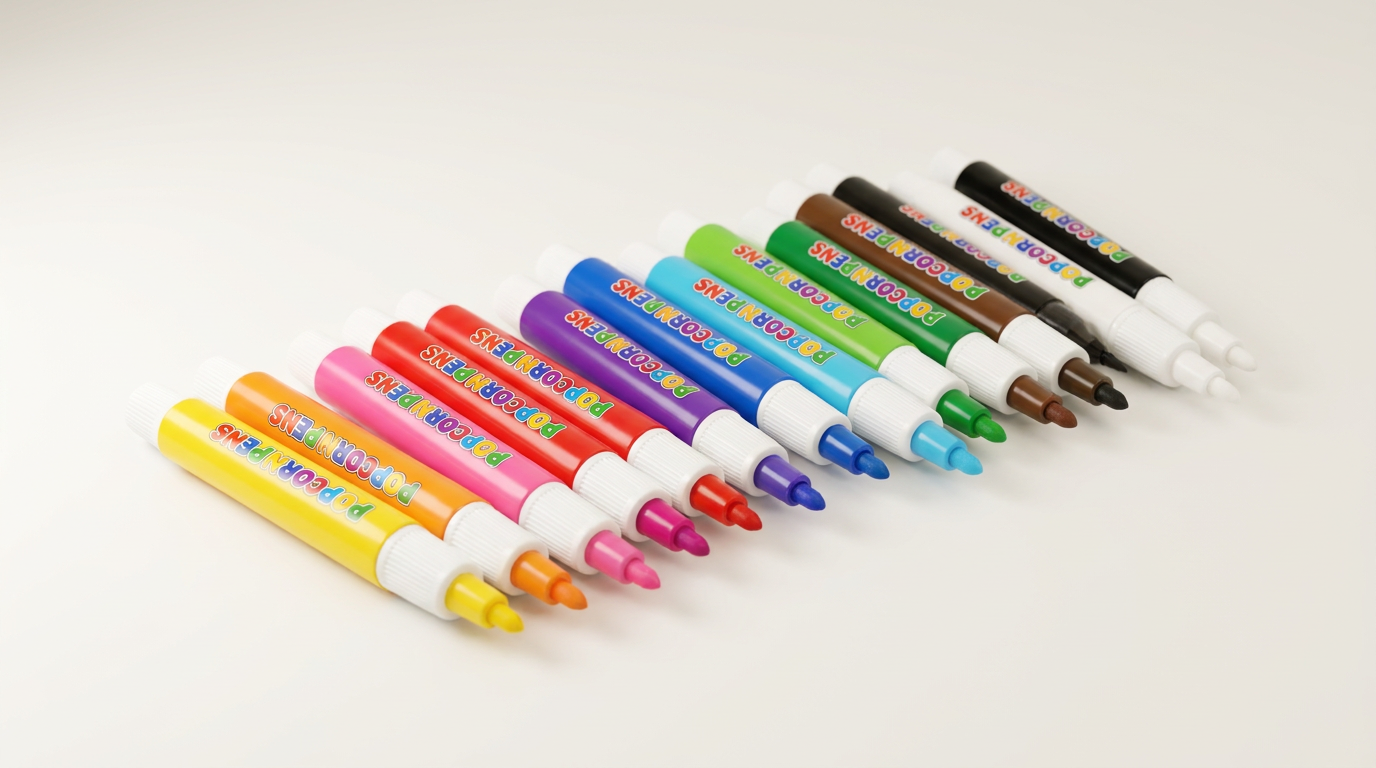
The modern craft aisle thrives on the promise of tactile transformation, and heat-activated bubble pens represent one of its most alluring micro-trends. Barods markets its Popcorn Pens as a simple, magical pathway to raised 3D artwork: draw on paper, apply a standard hair dryer, and watch flat lines expand into textured foam. It borrows the visual appeal of additive manufacturing and repackages it for the kitchen table, presenting itself as an accessible gateway to dimension-rich crafting for children and hobbyists alike.
Yet beneath the viral demonstration clips lies an acute reality gap. What Barods sells as a controlled thermal reaction instead manifests as what we call the activation gap, the stark chasm between an idealized craft chemistry and the volatile, mess-prone fluid delivered inside cheap plastic barrels. Instead of an intuitive creative tool, users encounter erratic flow, stubborn chemical formulas that resist heat, and ruined table surfaces.
In an entry-level market where a craft kit must deliver consistent, low-friction entertainment to justify its place in the drawer, the Barods 12-piece set falters on nearly every operational front. An overwhelming pattern of failed projects and stained clothing points to a fundamental breakdown in basic product execution.
What owners love
- + Bright, saturated liquid colors right out of the box
- + Generous 12-piece count across two separate packs
- + Compact barrel sizing scaled for smaller hands
- + Engaging theoretical concept for mixed-media craft projects
Common complaints
- − Fails to expand or puff up when exposed to heat
- − Nozzles clog severely or burst under normal hand pressure
- − Thin fluid smears easily and resists standard drying
- − Pigment causes permanent stains on clothing and surfaces
- − Defective cap assemblies with stuck internal seals
Design & Build
At first glance, the Barods Popcorn Pens mirror traditional gel or paint markers, featuring slim plastic barrels and snap-on caps intended to prevent premature drying. However, physical inspection reveals loose manufacturing tolerances that undermine basic operation before drawing even starts. Multiple owners note defective cap assemblies where the inner protective cap either separates entirely or remains jammed within the outer housing, rendering the pen difficult to open cleanly. The plastic casing offers uneven resistance: soft sections invite excessive squeezing, while the narrow tip assembly lacks an internal regulating valve. This creates what we identify as the hydraulic burst effect. When paint inevitably dries at the microscopic tip opening, the user must apply disproportionate pressure to break the blockage. The result is not a continuous, controlled bead of dimensional paint, but an uncontrolled rupture that spews pressurized liquid across craft tables and clothing. Furthermore, the pigment exhibits aggressive bonding characteristics on fabrics, leaving permanent stains that defeat the family-friendly premise of a child-focused art supply.
Setup & Ease of Use
The advertised workflow appears straightforward: sketch a design, allow the ink layer to rest briefly, and sweep a household hair dryer over the paper to trigger the expansion. In practice, the application process presents immediate ergonomic roadblocks, particularly for younger creators. The ink formula possesses an unpredictable viscosity that swings wildly between watery seepage and viscous sludge. Children as old as nine struggle to maintain an even line weight, as the pens alternate between stubborn refusal and sudden globbing. Kneading the pen body or shaking the reservoir yields little improvement. When line work does make it onto cardstock, the paint exhibits an abnormally long ambient drying time. Rather than setting smoothly to accept thermal transfer, the wet ink pools on the paper. Attempting to introduce the hair dryer early simply propels the runny pigment across the surface, ruining scrapbooks and greeting cards before any textural expansion can occur.
Performance in Real Use
The primary selling point of the Barods set is its heat-activated popcorn texture, yet real-world testing proves that the underlying chemical reaction is virtually absent. When exposed to hot air streams from standard hair dryers across various heat settings, distances, and exposure times, the applied lines stubbornly refuse to pop. The fluid either stays flat, forms a scorched, glossy skin, or remains permanently tacky to the touch. This total lack of expansion breaks the fundamental promise of the product. While an isolated owner reported that young grandchildren enjoyed the bright colors as basic markers, the vast majority of households describe complete mechanical failure. The paint simply does not transition from a liquid film to a solid cellular foam. For craft enthusiasts seeking the crisp dimension of true embossing or the soft volume of commercial puff paints, these pens behave like diluted acrylic ink packaged in fragile, temperamental dispensers.
Software & Ecosystem
Although categorized within digital indexing alongside entry-level additive manufacturing and hobbyist 3D pens, the Barods Popcorn Pens rely on passive thermal chemistry rather than powered hardware or active extrusion mechanisms. This analog nature means success depends entirely on ambient tools provided by the user, specifically a dependable hair dryer with variable airflow. However, the manufacturer supplies zero technical guidance regarding the critical balance of wattage, surface distance, or heat saturation. High-velocity airflow displaces the runny pigment instantly, while low-velocity heating fails to supply the threshold temperature needed to initiate foam expansion. Without proper application guides, thermal charts, or compatible project stencils, users are left to guess through destructive trial and error on their own paper stocks.
Value & Reliability
Priced in the budget tier under $30 for a 12-pack, the Barods kit attempts to undercut specialized embossing supplies and motorized craft accessories through sheer volume. Yet volume cannot substitute for baseline utility. When a consumable craft supply fails to perform its primary marketed function in nearly all reported scenarios, its effective cost per use skyrockets. Reliability across the multi-color set is consistently poor; individual pens arrive clogged, missing internal seals, or structurally compromised out of the box. The recurring complaints of ruined projects, stained garments, and lengthy delivery intervals paint an unmistakable portrait of zero quality control. The kit ultimately demands significant adult intervention, messy cleanup, and high frustration for an outcome indistinguishable from standard, inexpensive marker ink.
Verdict
Stay Away - The Barods Popcorn Pens completely fail to deliver on their promised heat-activated 3D puff effect while introducing significant mess and staining risks.
Craft hobbyists looking for tactile lettering should skip this set in favor of proven dimensional craft mediums, such as traditional fabric puff paints, squeezy relief liners, or authentic embossing powders paired with a focused heat gun. Parents and grandparents seeking an engaging, low-stress art project for children will find only disappointment, ruined table surfaces, and permanent clothing stains here.
This product is a textbook example of the novelty capture phenomenon, where viral visual trends outpace basic product formulation to sell an impossible result at a bargain price. Barods has packaged regular, inconsistent liquid pigment in substandard hardware and labeled it 3D art, leaving buyers with an unusable product that belongs nowhere near your craft desk.
FAQ
More 3D Printing Pens reviews
LTGEM 3D Printing Pen Hard Case Review
co2CREA Storage Case for 3D Printing Pen Review
Lebakort Storage Case for 3Doodler Start+ Review
SCRIB3D Advanced 3D Printing Pen Review: Beyond the Hobbyist
MYNT3D Super 3D Pen Review: A Low-Cost Creative Gateway
MYNT3D Professional Printing 3D Pen Review: Precision for Play
This review is based on real experiences shared by owners in online communities.