
Starry 6.0mm 3D Scanner Markers Review: Reliable Tracking Dots
By AValidReview. An AI-assisted summary of customer feedback, not a hands-on test.
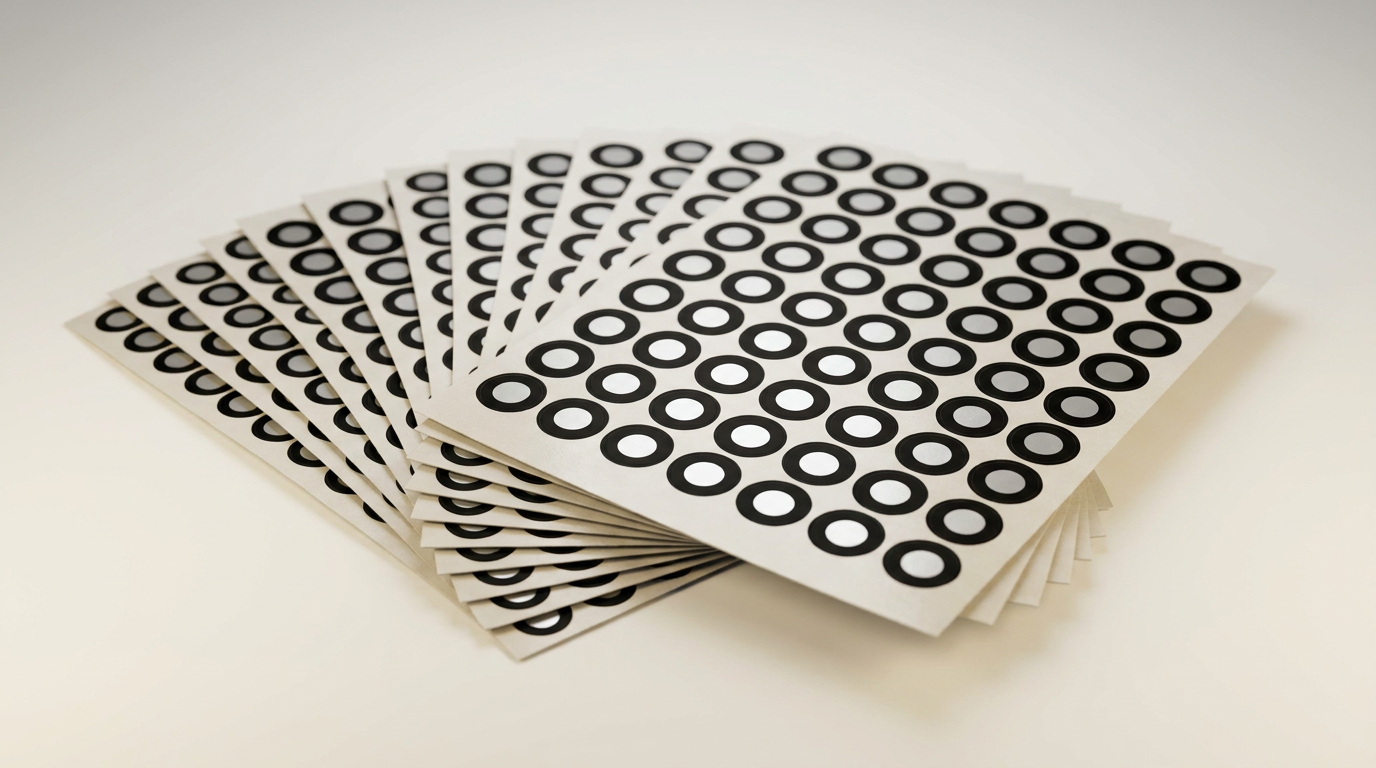
Consumer 3D scanners are frequently marketed on the promise of effortless, point-and-shoot geometry capture. In practice, the technology reliably collides with a condition known as tracking starvation. The moment a structured-light or infrared sensor passes over a symmetrical cylinder, a uniform flat plane, or a high-gloss surface, the software loses spatial awareness and tracking collapses. The typical bundled solution is an insulting envelope of fifty proprietary dots that users guard like gold leaf.
Starry solves this mismatch not by reinventing retroreflective science, but by turning reference targets from a precious consumable into an ambient utility. Supplying 700 markers across 14 sheets for a single-digit price, this pack directly combats marker rationing anxiety, allowing operators to pepper complex projects with the anchor density required for seamless point-cloud registration.
While marked as basic consumables, reference dots carry genuine engineering tolerances. If the retroreflective coating scatters unevenly, software centroids drift; if the adhesive is overly aggressive, clean teardown ruins delicate finishes. Starry hits a practical middle ground that functions across multiple scanner ecosystems, even if a few edge cases expose the limits of budget adhesive chemistry.
What owners love
- + Strong, balanced retroreflection across varied angles without blowing out sensors
- + Generous 700-marker volume eradicates target rationing during large scans
- + Reliable peel-and-stick tack on plastics, metal, glass, and bare wood
- + Clean residue-free removal on non-porous materials
- + Durable enough to be carefully transferred across multiple scan setups
Common complaints
- − Adhesion drops noticeably on treated, oiled, or textured wood finishes
- − Isolated reports of detection failures under specific infrared camera setups
- − 6mm footprint can be delicate to manipulate when working with gloved hands
Design & Build
The Starry markers arrive as 14 individually cut sheets containing 50 dots each, totaling 700 markers. Each target measures 6.0 mm in outer diameter, a standard sizing recognized across professional and hobbyist photogrammetry suites. The die-cutting across the sheets is precise; dots release cleanly along their outer perimeter without lifting the surrounding waste matrix or fraying at the edges.
The core of any tracking target is its retroreflective micro-structure. Rather than employing cheap metallic foils that create specular glare, Starry uses an engineered reflective face designed to return incoming illumination directly back toward the scanner source. This multi-angle reflection profile prevents the blooming artifacts that confuse registration algorithms. The backing material is stiff enough to prevent curling during peel-off, which ensures the dot lays dead flat against the scanned surface. Flatness is non-negotiable in metrology, as any target that puckers at the rim introduces artificial elevation noise into the reconstructed mesh.
Setup & Ease of Use
Application is straightforward, though handling 6.0 mm circles requires basic dexterity. For technicians working in industrial environments, peeling them while wearing nitrile gloves requires patience, but the backing sheet yields easily under a fingernail or tweezers. Adhesion across standard fabrication materials is dependable. Users report solid bonding to sheet metal, cast components, injection-molded plastics, laminate desks, and raw wood.
The limits of the pressure-sensitive adhesive show up primarily on treated woods, varnished surfaces, and oily substrates, where the dots can lift prematurely under air currents or movement. Conversely, on unsealed, fibrous materials like raw cutting boards, the glue bonds aggressively enough to require deliberate fingernail scraping during removal. On glass, smooth metals, and polished resin, removal is exceptionally clean, leaving no tacky residue or ghosting. Several users note that with careful handling, targets can even be transferred between sequential workpieces before the adhesive gives out entirely.
Performance in Real Use
In live scanning environments, the Starry dots deliver dependable spatial anchors. Owners of mid-tier hardware, including the 3DMakerPro Moose Pro and Einstar Rockit, report immediate target acquisition. Crucially, the reflectivity strikes the correct photometric balance: bright enough for structured light and standard infrared sensors to isolate high-contrast centroids instantly, but controlled enough to avoid overexposing tracking cameras into blinding white discs.
This balance directly enables what we call the spray substitute workflow. Many users reach for messy chalk or sublimating scanning sprays when dealing with smooth, dark, or translucent objects. Laying down a scattering of Starry dots frequently provides enough artificial geometry to bypass chemical surface preparation entirely. However, performance is not entirely universal. At least one user reported that the dots failed to return sufficient signal under their specific IR scanner arrangement. While the vast majority of consumer structured-light and near-infrared systems lock onto these targets without issue, operators running specialized narrowband optical hardware should verify their illumination frequency before committing to large-scale runs.
Software & Ecosystem
Because these are passive targets, their integration depends entirely on the host scanner software. Programs from Revopoint, Shining 3D, Creality, and 3DMakerPro rely on target-mode tracking algorithms to stitch sequential frames together. The high-contrast perimeter of the Starry dots gives point-cloud meshing engines a sharp, mathematically stable centroid to track across 360-degree rotations, drastically reducing the alignment errors that cause double-skinning artifacts.
Beyond traditional industrial reverse engineering, the utility of these targets extends into adjacent tracking disciplines. Field reports include users deploying the dots for motion capture pipelines, high-speed camera reference planes, and biomechanical bike-fitting systems. As long as the imaging camera utilizes a co-axial or near-axis light source, the retroreflective matrix returns high-contrast positional coordinates to third-party vision toolkits.
Value & Reliability
The economic math on generic consumables is simple, but in 3D scanning, value has a direct impact on operational quality. Name-brand scanner manufacturers often charge premium rates for replacement packs containing merely 100 or 200 dots. This pricing structure breeds marker rationing anxiety, encouraging users to space dots too far apart, leading to dropped frames and ruined scans.
Starry prices 700 markers in the sub-$15 tier, collapsing the cost per dot to a fraction of a cent. At this price tier, operators can place reference targets densely across complex assemblies, background plates, or scanning turntables without second-guessing the expense. Considering that the sheets ship in a resealable pouch to protect the retroreflective surface from ambient shop dust, the package provides lasting workshop utility.
Verdict
Buy - A high-utility, low-cost supply that eliminates tracking drift on featureless scans.
This pack is an essential purchase for any owner of a consumer or prosumer structured-light or infrared 3D scanner who works with smooth, symmetrical, or feature-poor components. It is equally valuable for hobbyists venturing into motion capture and reverse engineering who need cheap, reliable point anchors. Skip it only if your workflow is strictly confined to organic, heavily textured statues where marker tracking is unnecessary, or if you operate a proprietary optical scanner with strict non-standard dot geometry requirements.
The 3D scanning market spent years overpromising algorithm-only tracking, yet the physics of optical capture have not changed. Featureless planes will always confuse automated alignment. The Starry 700-pack demonstrates that sometimes the most effective hardware upgrade in additive manufacturing is not a smarter sensor, but an abundance of cheap, dependable retroreflective targets.
FAQ
More 3D Scanners reviews
Creality Scan Bridge Review: Wireless Freedom at a Cost
Kingdder Magnetic 3D Scanning Marker Review
Einstar 3D Handheld Scanner Review: Pro Hardware, Strict Demands
Marspark 6mm 3D Scanning Markers Review: Smart Consumables
HogarDeco 6mm 3D Scanner Markers Review
Creality CR-Scan Ferret Pro Review: Budget Reality Check
This review is based on real experiences shared by owners in online communities.