
Polymaker PLA PRO: Rethinking Functional PLA for Everyday 3D Printing
This review is based on real experiences shared by owners in online communities.
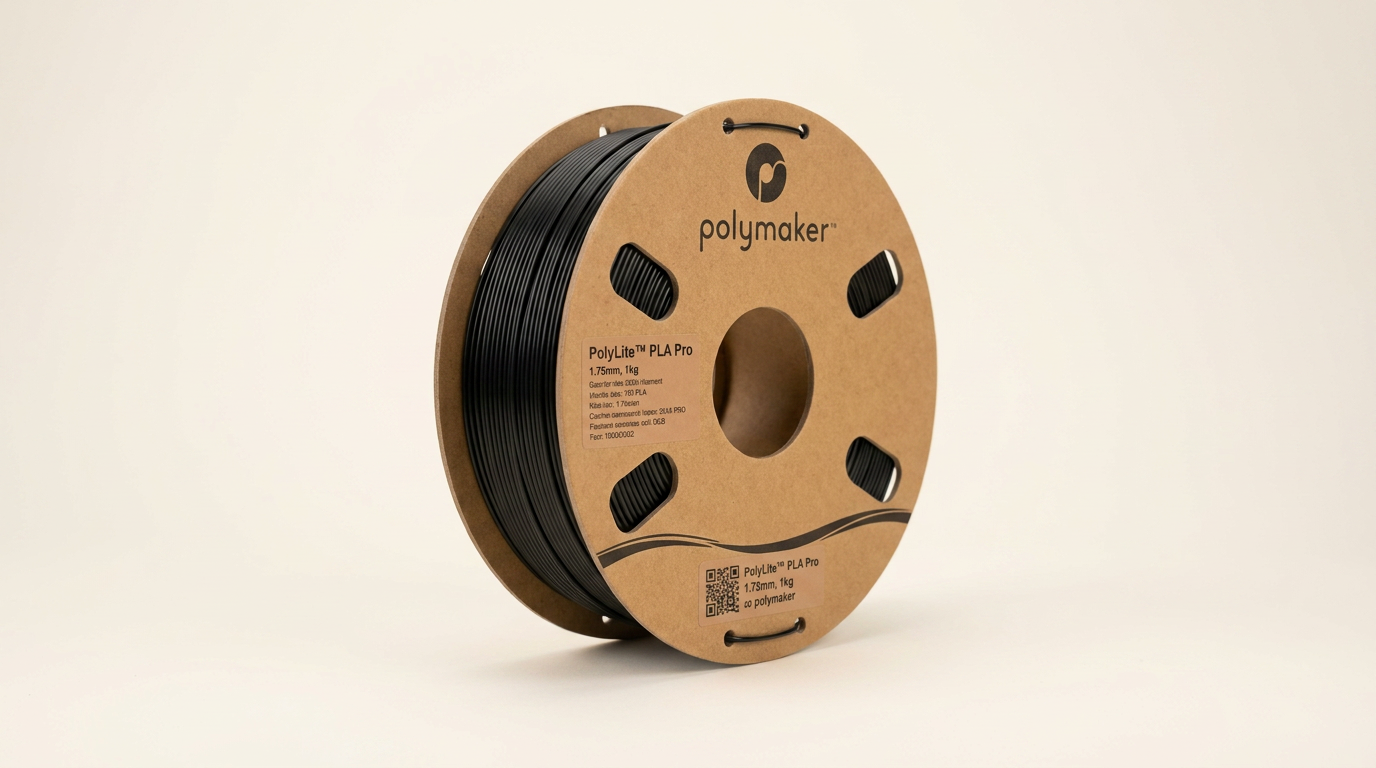
In a 3D printing landscape dominated by increasingly specialized materials, standard PLA often serves as a low-cost, low-effort entry point. Polymaker's PLA PRO challenges this perception, aiming to elevate PLA into a material capable of functional, stress-bearing applications typically reserved for PETG or even ABS. This repositioning is significant, suggesting a new 'everyday advanced' category for casual users and professionals alike: a filament that combines the printability of PLA with the mechanical properties approaching engineering plastics, without the associated print complexity.
While the market offers numerous "PLA+" variations, Polymaker's PRO designation implies a more substantial engineering effort toward enhanced toughness and rigidity. This review examines whether this filament delivers on that promise, assessing its real-world performance against the backdrop of its cost and the prevailing expectations for a material still rooted in the PLA family. It specifically investigates if the claimed PRO performance translates reliably across various printer setups and user experience levels.
Our analysis uncovers a tension between broad compatibility claims and the reality of achieving optimal results, revealing what we term the "optimization tax" for unlocking its full potential. This tax surfaces as a recurring need for users to fine-tune settings beyond generic PLA profiles, despite manufacturer assurances of out-of-the-box ease. Understanding this balance is key to determining if Polymaker PLA PRO truly serves as a superior, simplified alternative for functional prints.
What owners love
- + Significantly higher impact resistance and mechanical strength than standard PLA
- + Consistent print quality with strong layer adhesion and minimal stringing
- + Matte finish provides a professional aesthetic for printed parts
- + Reliable bed adhesion and consistent filament diameter
- + AMS compatibility due to optimized, strong cardboard spool design
Common complaints
- − Rougher texture on some colors may cause issues with PTFE bowden tubes
- − Some users report a stronger odor compared to typical PLA
- − May require minor calibration or setting tweaks for optimal results on certain printers
- − Perceived premium pricing compared to budget PLA options
- − Specific colors may behave differently, necessitating individual tuning
Design & Build
Polymaker PLA PRO arrives on a cardboard spool, a common choice for environmental considerations and AMS compatibility. Owners consistently praise the spool's wind quality, noting it is tightly wound with no tangles, contributing to reliable feeding. The material itself is noted for having a consistent diameter across multiple rolls, a critical factor for print reliability. While the cardboard spool is generally optimized for AMS systems, one specific mention of a "sparkle green" color highlights that some variants may exhibit a significantly rougher texture. This texture, described as almost sandpaper-like, can be problematic for printers using bowden tube systems, specifically those with PTFE tubing, potentially hindering smooth feeding. This points to a slight inconsistency in surface finish across the color lineup, introducing a variable for users with specific printer configurations.
Setup & Ease of Use
The filament is marketed as easy to print, often performing well with standard PLA settings across various machines, including Bambu Lab P1S, Prusa MK4S, and Flashforge Adventurer 5M Pro. Several owners experienced successful first prints without significant adjustments, validating the plug-and-play claim for many. However, a segment of users, particularly those with Bambu Lab printers, found the need to adjust settings to resolve bed adhesion issues, suggesting that while the material is generally forgiving, it is not entirely immune to the "optimization tax." Drying the filament is also noted as beneficial by this group, indicating that while Polymaker aims for a moisture-free experience, environmental factors or transit can still necessitate pre-printing conditioning. The explicit print settings provided on the roll and website are a valued resource for those needing to fine-tune beyond stock profiles.
Performance in Real Use
The primary differentiator for Polymaker PLA PRO is its mechanical performance. Owners frequently report a significant increase in toughness and rigidity compared to standard PLA, often equating its strength to PETG or even some ASA parts for non-high-temperature applications. Terms like "unreal performance," "very strong," and "impact resistance" are common. This enhanced durability allows for the creation of functional parts like vacuum caps, hose connectors, and RC boat components without the typical fragility of regular PLA. Layer bonding is consistently described as robust, resisting snapping along layer lines, a common failure point for softer PLAs. The resulting prints exhibit a consistent matte finish, contributing to a professional appearance. Owners also note good bridging and overhang performance. A recurring observation, however, is a more pronounced odor during printing compared to conventional PLAs, a trade-off for its enhanced properties.
Software & Ecosystem
Polymaker PLA PRO integrates well within existing 3D printing ecosystems, requiring no proprietary software or hardware. Its general compatibility with standard FDM printers, from Ender devices to top-tier Bambu Lab and Prusa machines, confirms its broad applicability. The optimized cardboard spool design is a deliberate nod to modern multi-material systems like Bambu Lab's AMS, ensuring smooth feeding and automated filament swapping. This design choice anticipates the increasing prevalence of advanced printer features, positioning the filament as a more versatile option for complex workflows. While requiring specific tuning for some setups, the availability of settings parameters directly on the spool and website streamlines the process, demonstrating a commitment to supporting users within their preferred slicing software and printer environments.
Value & Reliability
Owners generally view Polymaker PLA PRO as a cost-effective choice within its performance class. While it may be priced slightly higher than basic PLA options, users widely agree that its enhanced strength, reliability, and reduced reprinting due to failures justify the investment. Many state that the higher quality saves headaches and wasted material, especially on long prints. The filament's consistent performance, low instances of clogged nozzles, and reliable bed adhesion despite potential initial calibration needs, underscore its overall reliability. Long-term users who rely on the filament for business production attest to its consistent quality. This reliability, combined with its improved mechanical properties, establishes it as a strong contender in the functional prototyping and end-use part segment, offering a compelling balance of quality and utility for its price point, which typically falls in the ~$20 to $30 range.
Verdict
Buy - Polymaker PLA PRO consistently delivers on its promise of enhanced strength and reliable printing for functional parts.
This filament is an excellent choice for makers who require prints with significantly higher impact resistance and rigidity than standard PLA, but want to avoid the printing complexities often associated with materials like PETG or ABS. It suits hobbyists creating durable models and professionals prototyping functional components. Those looking for a budget-bin PLA or who are unwilling to perform minor calibration for optimized results might find themselves paying the "optimization tax" without receiving full value. Its price point typically lands in the mid-range for premium PLA blends, making it a viable upgrade.
Polymaker PLA PRO represents the quiet evolution of what foundational materials can achieve. It subtly reshapes expectations for PLA, moving it from a simple prototyping material to a genuinely functional engineering plastic. This material exemplifies a new "engineered compromise" in 3D printing; it sacrifices a degree of the absolute ease of basic PLA for a substantial leap in mechanical performance, without demanding the environmental controls or advanced hardware of true engineering polymers. It's a pragmatic choice for the maker whose projects occasionally touch the limits of conventional PLA rigidity.
FAQ
More 3D Printing Supplies reviews
RAMBERY Silk Dual Color PLA Filament Review: Aesthetic Impact for Small Prints
eSUN PLA+ Filament: The Go-To Choice for High-Speed 3D Printers
SUNLU High Speed PETG Filament Review: The 'Dry-First Economy' Advantage
ERYONE Silk Filament PLA+ Review: The Glossy Aesthetic Standard
ELEGOO Matte PLA Filament Bundle Review: A Premium Material on a Budget
ELEGOO PLA Plus Filament Review: The Workhorse White
This review is based on real experiences shared by owners in online communities.