
Marspark 6mm 3D Scanning Markers Review: Smart Consumables
By AValidReview. An AI-assisted summary of customer feedback, not a hands-on test.
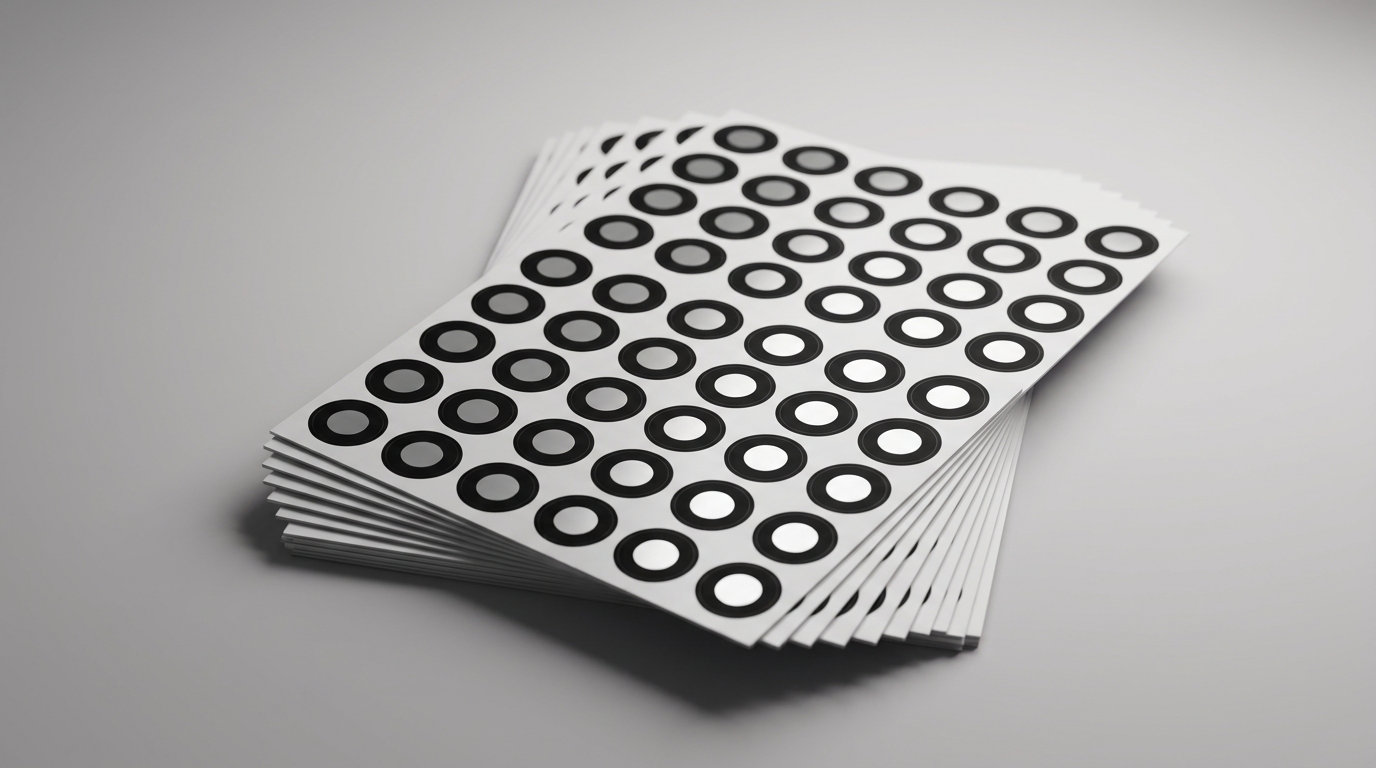
First-party 3D scanner accessories operate on a quiet extortion model. Handheld optical and laser scanners rely on retroreflective targets to maintain spatial orientation across featureless surfaces, yet hardware manufacturers package target dots like precious optical glass, charging steep markups for tiny circular stickers. This creates an artificial scarcity mindset where users waste time carefully peeling, preserving, and hoarding dots instead of focusing on clean point-cloud capture.
The Marspark 6mm 3D Scanning Markers challenge this dynamic by treating tracking dots as what they actually are: disposable workshop consumables. Providing 1,500 points spread across 30 sheets for under $20, this bulk pack lowers the psychological barrier to properly seeding a scan subject. Instead of skimping on points and suffering tracking loss, users can saturate a complex part with geometric anchors without worrying about the bill.
While marketing materials lean into claims of durable reusability, lived workshop experience tells a different story. These markers reveal an industry split: first-party targets engineered for repeated re-adhesion versus high-volume alternatives meant to be used twice and discarded. For practical digitizing setups, that trade-off makes complete economic sense.
What owners love
- + Generous 1,500-count pack provides high coverage for large capture volumes
- + Reliable geometric tracking with major consumer and prosumer scanners
- + Adhesive peels away cleanly without leaving gummy residue on parts
- + Extremely low per-dot cost shifts workflow toward disposable convenience
Common complaints
- − Adhesive tack drops significantly after one or two applications
- − Reflective intensity is slightly dimmer compared to OEM targets
- − Reusability claims do not hold up against premium alternatives
Design & Build
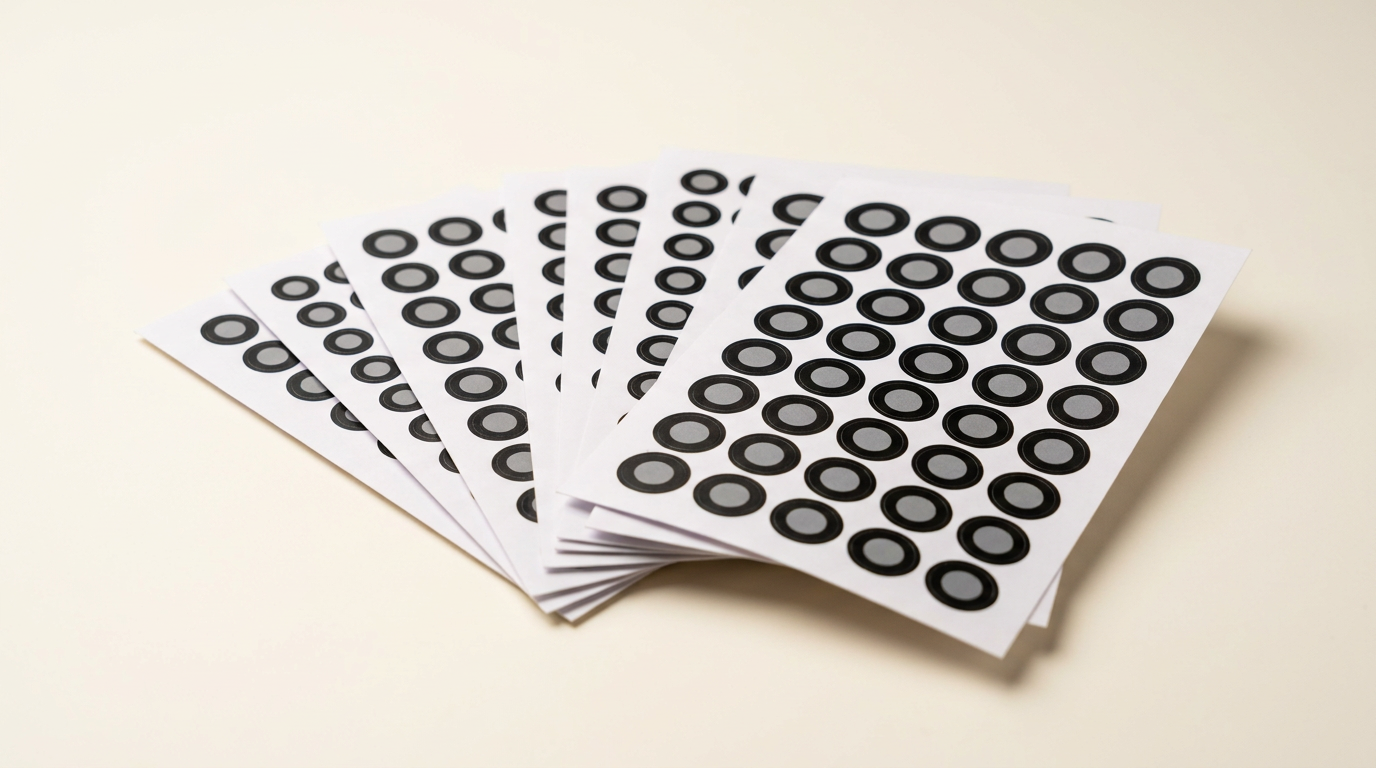
Each sheet in the Marspark bundle carries 50 die-cut markers measuring 6mm in outer target diameter, constructed on a flexible PVC substrate. The physical layout makes peeling quick, with enough margin around each circle to lift edges without creasing the retroreflective face. Compared directly to original equipment dots from brands like Revopoint or Shining 3D, the Marspark dots show a subtle visual variation in their retroreflective layer. The material is slightly less mirror-bright under ambient ambient lighting, showing a flatter silver-gray sheen. Despite the minor cosmetic variance, the die-cuts are uniform and free of ragged vinyl edges, which is critical for optical software that determines the marker centerpoint down to sub-millimeter tolerances.
Setup & Ease of Use
Applying the markers across curved sheet metal, cast components, and machined plastics is straightforward. The backing adhesive provides sufficient initial grab to adhere across gentle contours and vertical faces without peeling back. Removal is equally predictable: owners report that the markers pull off in a single piece, leaving zero adhesive residue or surface staining on finished parts. The friction point surfaces when attempting repeated cycles. While some OEM targets rely on specialized rubberized adhesives that maintain grip across a dozen applications, Marspark utilizes a standard acrylic-style adhesive. It grips well out of the gate, but airborne dust and surface shear rapidly exhaust the tack.
Performance in Real Use
In practical scanning sessions, Marspark targets deliver what can be called tracking anchor parity. When paired with hardware like the Revopoint MetroX, Inspire 2, or Creality Raptor Pro, the dots register immediately within the capture software. Scanners identify the high-contrast targets against the dark carrier ring, maintaining a steady tracking lock through rapid angle changes and sweeping passes. The slightly lower reflectivity noted in physical inspection does not manifest as dropped frames or lost point alignment in either near-infrared or blue-laser capture modes. However, real-world utility is defined by the Two-Stick Threshold: after placing a dot on an initial part and transferring it to a second, tack drops off sharply. Attempting a third application usually results in curling edges that can snag or misalign the spatial calculation.
Software & Ecosystem
Because these targets conform to the standard 6mm outer profile, software compatibility is universal. Optical tracking engines identify circular targets by contrast thresholding and geometric validation rather than proprietary digital signatures. As a result, software packages from Revopoint, Shining 3D, Creality, and general photogrammetry suites recognize the points identically to brand-name consumables. Users do not need to alter optical exposure or tweak target detection thresholds in their scanning software to pick up the dots, even when working under moderate studio lighting.
Value & Reliability
The core justification for Marspark rests on resolving the Consumable Paradox. Manufacturers want users to treat stickers as durable tools, but scanning environments are dirty, dusty, and abrasive. Attempting to preserve dots costs more in labor time than the stickers are worth. At around $15 to $20 for 1,500 points, Marspark reduces the cost per dot to a fraction of a cent. Even if each target only survives two scans before heading to the trash bin, the cost-to-utility ratio trounces expensive proprietary refill packs. For high-volume digitizing, prototype validation, and automotive body scanning, the reliability comes from volume: you can place as many dots as the geometry requires without rationing.
Verdict
Buy - The most sensible consumable upgrade for hobbyist and prosumer scanning workflows.
This pack is ideal for reverse-engineering hobbyists, automotive fabricators, and small inspection labs using scanners from Revopoint, Creality, or 3DMakerpro who want to stop treating positioning targets like fine jewelry. If your projects demand rapid part prep where markers are discarded after the scan, Marspark is the pragmatic choice. Skip this purchase only if your scanning regime relies on magnetic or rigid reusable targets designed for high-heat industrial inspection fixtures.
The real benefit here is behavioral rather than material. When positioning targets cost pennies instead of dollars, operators place more markers, track tighter arcs, and prevent scan registration failures before they happen.
FAQ
More 3D Scanners reviews
Einstar 3D Handheld Scanner Review: Pro Hardware, Strict Demands
HogarDeco 6mm 3D Scanner Markers Review
Creality CR-Scan Ferret Pro Review: Budget Reality Check
3DMakerpro Fox Review: Budget 3D Scanning with Real Trade-offs
Revopoint INSPIRE 2 3D Scanner Review: Unpacking the Accessory Echo Chamber
Creality 6mm 3D Scanning Markers Review: Essential Tracking Aid
This review is based on real experiences shared by owners in online communities.