
HogarDeco 6mm 3D Scanner Markers Review
By AValidReview. An AI-assisted summary of customer feedback, not a hands-on test.
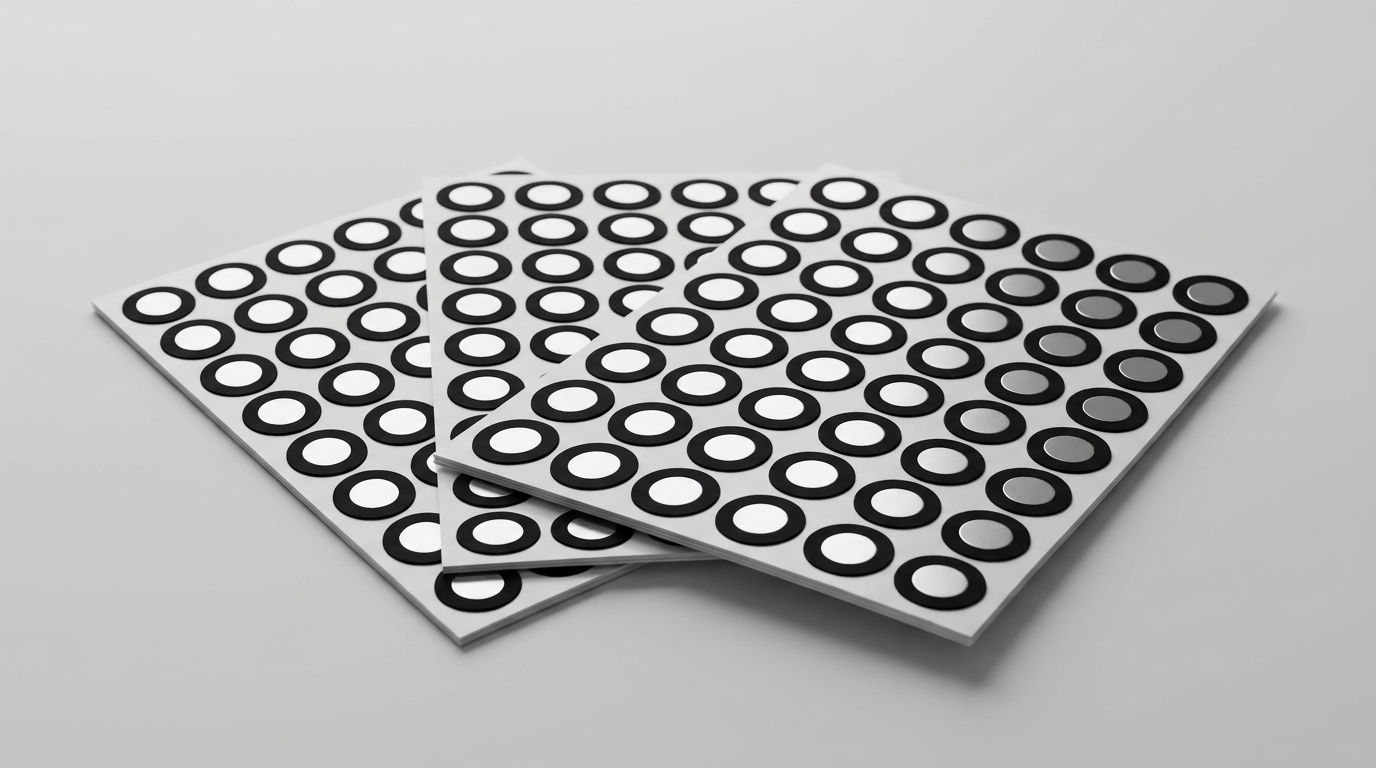
Consumer and prosumer 3D scanning hardware has advanced rapidly, but optical geometry algorithms still face an inescapable physics problem: the feature desert. When attempting to digitize an automotive fender, a sheet metal enclosure, or an untextured injection-molded casing, structured light and infrared sensors lose tracking within seconds. The hardware relies on high-contrast fiducials to stitch point clouds into a coherent surface mesh. Yet first-party scanner manufacturers treat these consumable stickers as profit centers, charging premium rates for simple reflective film.
HogarDeco takes direct aim at this OEM consumable tax with its 500-piece pack of 6.0mm inner diameter targets. Sized with a 6mm retroreflective core and a 10mm high-contrast black border, these diffuse tracking dots promise identical optical response to the packs bundled with expensive handheld rigs. The question for reverse-engineering shops and prototyping labs is whether budget optical targets introduce tracking drift or surface adhesion headaches.
After evaluating how these markers behave under real scanning workflows across various handheld systems, their utility is clear. They dismantle the high-cost barrier of sacrificial tracking aids, even if their geometry requires careful attention during specialized jigging setups.
What owners love
- + Optical tracking fidelity matches expensive OEM scanner markers
- + Adhesive bonds securely while peeling away cleanly with zero residue
- + Generous 500-count pack lowers the cost per scan dramatically
- + Broad hardware compatibility across structured light, laser, and IR systems
- + Essential for resolving tracking loss on planar or reflective surfaces
Common complaints
- − Total footprint is 10mm, causing fit issues in custom 6mm machined recesses
- − Essentially single-use unless manually backed with magnets
- − Slightly coarser reflective bead texture than top-tier metrology grade targets
Design & Build
At first glance, an optical marker appears trivial, but its performance hinges on precision geometry. HogarDeco structures each marker as a concentric target: an inner 6.0mm retroreflective circle surrounded by an outer 10.0mm matte black ring. The dark border provides the sharp edge contrast required by computer vision thresholds, while the inner core bounces illumination back along the incident light path. However, buyers designing custom scanning fixtures frequently stumble into what can be termed the footprint trap. Because marketing highlights the 6mm tracking core, some fabricators drill 6mm relief pockets into reference plates, only to find the 10mm exterior sticker will not seat flush. The reflective layer utilizes glass microbead deposition that exhibits a marginally coarser grain than certified industrial standards. Under extreme close-up inspection, the bead field is slightly irregular, but for handheld optical sensors operating at standard focal distances, the geometric center point calculates cleanly.
Setup & Ease of Use
Application is straightforward, with the 500 markers distributed across ten sheets of fifty. The adhesive layer strikes a critical balance: tacky enough to grab anodized aluminum, painted automotive panels, and slick plastics, yet formulated with low sheer resilience so it removes without gumming up the workpiece. In high-throughput shops, peeling and sticking dozens of individual targets represents real labor overhead, but the die-cut release paper allows fast peeling without tearing the reflective membrane. A persistent practical reality of adhesive markers is their disposable nature. Removing them generally creases the backing foil, rendering them one-time consumables. Savvy operators frequently deploy a workshop reusability hack: mounting these stickers onto miniature neodymium disc magnets or plastic standoffs to create reusable magnetic markers for ferrous parts and scanning turntables.
Performance in Real Use
In practical scanning runs across flat, featureless geometry, the HogarDeco markers perform admirably. Without fiducials, moving across a smooth, uniform surface causes alignment algorithms to slip, creating distorted double walls and spatial drift. Applying these targets in an asymmetrical array restores solid lock immediately. The retroreflective cores light up brightly in infrared monitoring feeds, providing deterministic anchor points that keep point clouds rigid over long spans. Tracking holds stable on structured-light rigs as well as laser and IR units. The slightly anisotropic nature of the reflective beads means tracking confidence can dip marginally at steep, grazing angles compared to premium metrology targets. However, as long as the scanner maintains a working angle between 45 and 90 degrees relative to the surface normal, frame acquisition remains uninterrupted.
Software & Ecosystem
Because these targets rely on passive diffuse reflection rather than coded patterns, they operate across virtually any software ecosystem that supports marker-based alignment. Users pairing them with scanning suites from Creality, Revopoint, Shining 3D, and 3DMakerpro report instant target identification without needing manual exposure calibration. Some hardware prompts suggest avoiding reflective targets in specific modes, yet real-world workflows show the contrast profile registers cleanly as long as IR brightness is adjusted to prevent sensor blooming. Handheld tracking software automatically computes the centroid of the 6mm reflective dot, treating it identically to the first-party targets included in original hardware cases. Beyond scanning, the markers also register effectively with optical motion-capture and infrared computer vision setups.
Value & Reliability
Value is where the HogarDeco 500-pack fundamentally alters the economics of 3D scanning. First-party target packs often command steep markups for quantities as small as one or two hundred pieces, encouraging users to conserve markers and risk tracking failure on complex scans. At a price band well under $20 for 500 units, the cost per dot drops to pennies. This allows technicians to blanket large automotive panels, tooling dies, and architectural castings with abundant tracking geometry without worrying about running down expensive inventory. Given that shelf life is governed solely by adhesive dry-out over several years, keeping a bulk supply in a sealed drawer is an easy operational decision for any fabrication studio.
Verdict
Strong Buy - Indistinguishable in optical performance from proprietary targets, this bulk pack eliminates the costly consumable barrier in 3D scanning workflows.
This pack is an essential purchase for reverse-engineering professionals, 3D printing service bureaus, and hobbyists operating handheld scanners from brands like Revopoint, Shining 3D, and Creality. Anyone struggling with tracking drift across smooth, flat, or dark surfaces will benefit immediately from keeping these targets on hand. Skip this specific product only if your workflow requires high-precision metrology certified to microscopic tolerances, or if you strictly need miniature coded targets that carry individual numerical IDs for automated photogrammetry.
The broader lesson of the HogarDeco markers is that passive optical tracking is entirely commoditized. First-party scanner vendors charge metrology-level prices for what is fundamentally punched reflective tape. Buying third-party fiducials is not a compromise on mesh accuracy; it is the correction of an artificial ecosystem markup.
FAQ
More 3D Scanners reviews
Einstar 3D Handheld Scanner Review: Pro Hardware, Strict Demands
Marspark 6mm 3D Scanning Markers Review: Smart Consumables
Creality CR-Scan Ferret Pro Review: Budget Reality Check
3DMakerpro Fox Review: Budget 3D Scanning with Real Trade-offs
Revopoint INSPIRE 2 3D Scanner Review: Unpacking the Accessory Echo Chamber
Creality 6mm 3D Scanning Markers Review: Essential Tracking Aid
This review is based on real experiences shared by owners in online communities.