
Creality CR-Scan Ferret Pro Review: A Novice's 3D Scanner
This review is based on real experiences shared by owners in online communities.
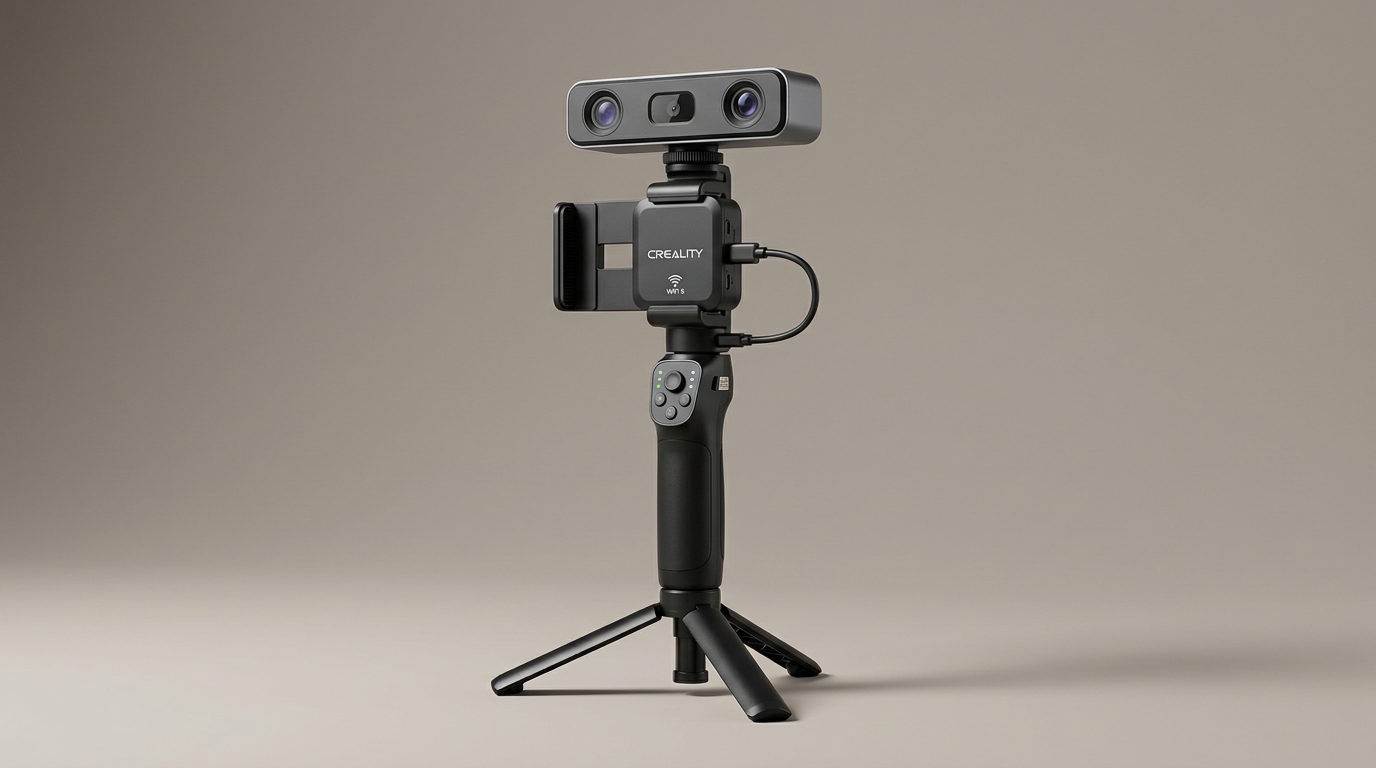
The Creality CR-Scan Ferret Pro enters a market crowded with devices promising high-precision 3D capture for both professionals and enthusiasts. While the segment often emphasizes raw technical specifications, the true test for a scanner like the Ferret Pro lies in its practical utility for its target audience: beginners and DIY creators. This scanner attempts to bridge the gap between complex industrial tools and accessible consumer technology, offering features typically found in higher-end models, such as Wi-Fi 6 connectivity and anti-shake tracking.
However, the promise of ease and accuracy often encounters friction in real-world application, particularly when scanning objects with intricate geometries or challenging surfaces. The question for potential buyers is not merely what the Ferret Pro *can* do on paper, but what it consistently achieves in the hands of an average user. This review evaluates whether its design choices effectively minimize the common frustrations associated with 3D scanning, or if it merely adds another option to a niche already served by more established solutions.
Ultimately, the Ferret Pro embodies what we call the "entry-level paradox": a product designed to lower the barrier to entry, but which may still require a significant learning curve or compromise on results when pushed beyond basic use cases. Understanding this dynamic is key to assessing its true value in a workshop or studio setting.
What owners love
- + Promotes ease of use for beginners
- + Supports wireless scanning with Wi-Fi 6
- + Claims anti-shake tracking for smoother capture
- + Designed to scan dark, metallic, and matte objects without spray
- + Offers outdoor scanning capabilities up to 30,000 lux
Common complaints
- − Struggles with tracking on complex or tight geometries
- − Not suitable for precise engineering or design applications
- − Potential for inconsistent results in practical scenarios
- − Limited evidence of high accuracy in real-world use
- − May serve primarily as a novelty device for artistic purposes
Design & Build
The CR-Scan Ferret Pro presents a compact and lightweight form factor, consistent with its positioning as a portable, handheld scanner. Manufacturer claims emphasize a design philosophy focused on accessibility, touting low power consumption suitable for various portable scenarios. The device supports color scanning, which broadens its utility for applications where visual fidelity is important. Owners have not provided extensive feedback on the physical construction, suggesting it meets baseline expectations without significant issues or standout features. The overall design prioritizes portability and straightforward operation, aligning with the needs of hobbyists rather than industrial users.
Setup & Ease of Use
Creality markets the Ferret Pro as highly suitable for beginners, DIY creators, and 3D printing enthusiasts. The inclusion of Wi-Fi 6 for wireless transmission aims to simplify the setup by removing cable clutter and promising stable, low-latency data transfer. This approach aligns with a modern user experience, particularly for those integrating the scanner into a mobile workflow with Android or iOS devices. However, the practical "ease of use" can diverge from theoretical design. While the initial connection might be simple, the actual scanning process, particularly tracking complex objects, introduces challenges that can quickly offset any initial setup simplicity. The one verified owner indicates that even with features like anti-shake tracking, difficulties in marker tracking, especially in tight areas, can hinder an otherwise straightforward process. This suggests a "surface-level simplicity" that does not fully translate into a "functional simplicity" for all scanning tasks.
Performance in Real Use
The Ferret Pro targets high-detail 3D models with up to 0.1mm accuracy and 0.16mm resolution, along with 30FPS high-speed scanning. Key features like anti-shake tracking, using one-shot 3D imaging, are designed to maintain accuracy even with hand movements. The ability to scan dark, metallic, and matte surfaces without spray, and perform reliably outdoors in up to 30,000 lux sunlight, are significant manufacturer claims that address common pain points in 3D scanning. However, the limited owner feedback directly contradicts some of these performance assurances. A recurring theme, despite manufacturer claims, is difficulty with tracking, particularly in confined spaces or on objects with challenging geometry. One owner reported the scanner "couldn’t pick up on tracking markers," making it unsuitable for detailed engineering or design work. This suggests a potential gap between stated capabilities and consistent real-world output, indicating that its "anti-shake tracking" may be less robust in varied environments. The device's practical performance appears to restrict its use to more forgiving, visually oriented projects, reinforcing its character as a "novelty scanner for artsy things" rather than a precision instrument. This performance gap defines what we might call the 'tracking resilience ceiling'-- the point at which the scanner's tracking algorithms fail to maintain consistent capture on non-ideal surfaces or complex shapes, despite advertised anti-shake technologies.
Software & Ecosystem
The Ferret Pro offers broad compatibility across Windows, macOS, Android, and iOS devices, requiring specific RAM and processor specifications. This multi-platform support, coupled with seamless integration with major 3D software, indicates an effort to build a versatile ecosystem. The Wi-Fi 6 wireless transmission directly benefits this, aiming for stable, low-latency data transfer across devices. While the software itself is not extensively detailed in owner feedback, the scanner's utility is inherently tied to its accompanying applications for capture, processing, and export. The success of the "easy to use for beginners" claim depends heavily on intuitive software interfaces and reliable processing. The fact that the device struggles with tracking suggests that even with broad compatibility, the core software algorithms for data acquisition and stitching may not consistently deliver the advertised accuracy and ease for all object types. This disparity points to an ecosystem that, while broad, may not always deliver robust results in practice, particularly when precise data capture is required for downstream engineering or design tasks.
Value & Reliability
Priced in the upper hundreds, the Ferret Pro positions itself as an accessible option compared to professional-grade industrial scanners, while still being a significant investment for a hobbyist. Manufacturer claims of 0.1mm accuracy and robust tracking capabilities aim to justify this cost by offering premium features at a more consumer-friendly price. However, the reliability observed by owners, particularly concerning consistent tracking and detail capture, suggests a divergence from marketing promises. The sentiment that it is a "novelty scanner for artsy things" rather than a tool for serious engineering indicates a perceived lack of value for precision-focused applications. The implied longevity of the device and its consistent performance under varied conditions remain largely unaddressed by owner feedback, but the initial reports on tracking issues raise questions about its long-term utility for anything beyond simple, undemanding scans. This creates a "practicality deficit" where the device's technical specifications do not consistently translate into reliable functional output across a range of common scanning challenges.
Verdict
Hold Off - The Creality CR-Scan Ferret Pro struggles with fundamental tracking reliability, limiting its utility for serious 3D design or engineering applications.
This scanner might appeal to casual users or hobbyists primarily interested in capturing simple, non-critical objects for artistic endeavors or basic volumetric scans, particularly if budget is a primary concern in the mid-hundreds range. Its wireless capabilities and purported ease of use could make it suitable for those experimenting with 3D scanning for the first time, provided their expectations for precision are modest. Individuals seeking a straightforward tool for very large, unchallenging objects without fine details might find it acceptable.
However, those requiring consistent accuracy, reliable tracking for complex geometries, or a device for engineering, reverse engineering, or high-fidelity design work should look elsewhere. The documented issues with marker tracking and general capture robustness indicate it is not suited for professional or semi-professional applications. Buyers needing a tool that can reliably handle intricate parts or tight spaces, even if it means investing significantly more, should skip this model.
The Ferret Pro inadvertently highlights a critical inflection point in consumer 3D scanning: the transition from 'scanning as a novelty' to 'scanning as a precise tool.' Its current iteration exists firmly in the former camp, demonstrating that technical specifications alone do not guarantee practical performance, especially when core algorithms for tracking and data integrity fall short under varied real-world conditions. This product serves as a cautionary tale against relying on feature lists without thoroughly vetting real-world capture consistency.
FAQ
More 3D Scanners reviews
Creality 6mm 3D Scanning Markers Review: Essential Tracking Aid
TOSUKKI 6mm Positioning Targets Review: The Refined Generic Choice
AESUB 3DTOOLS 3D Scanner Spray Review: The 'Evaporative Enabler'
Creality 8-inch Rotating Turntable: A Solid Scanner Accessory

Generic 12 Piece Multi-Angle Markers Review: Essential 3D Scanning Dots
3DMakerpro Moose Standard Review: High Detail for the Serious Hobbyist
This review is based on real experiences shared by owners in online communities.