
AESUB 3DTOOLS 3D Scanner Spray Review: The 'Evaporative Enabler'
This review is based on real experiences shared by owners in online communities.
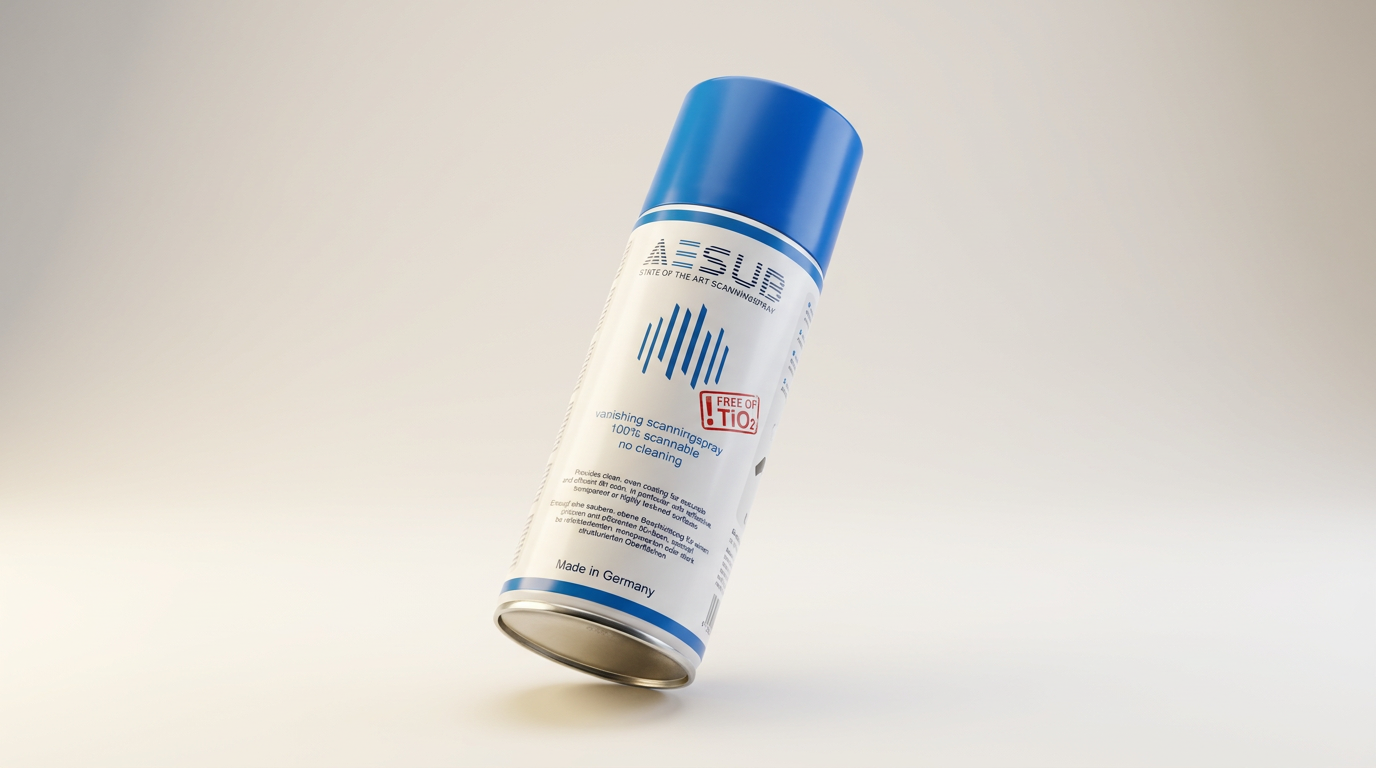
In the evolving landscape of consumer-grade 3D scanning, achieving accurate data capture often hinges on surface preparation. While many users initially seek DIY alternatives like foot powder, the AESUB 3DTOOLS 3D Scanner Spray represents a dedicated, purpose-built solution. This product challenges the assumption that cheaper, off-label methods suffice, positioning itself as a premium utility for overcoming common scanning obstacles.
Most entry-level 3D scanners struggle with highly reflective, transparent, or dark objects. These surfaces scatter or absorb light in ways that prevent the scanner from accurately mapping geometry. Dedicated scanning sprays are designed to create a uniform, matte coating, providing the necessary contrast for optical scanners. The core promise of the AESUB spray is its "self-evaporating" characteristic, aiming to eliminate post-scan cleanup time, which can be a significant cost multiplier in professional or hobbyist workflows.
This review examines whether the AESUB spray delivers on its core promise of performance and convenience, considering user experiences with evaporation times, residue concerns, and its overall impact on scan quality. We explore its role as an 'Evaporative Enabler' in the scanning process, facilitating quicker, more accurate captures without the downstream burden of material removal.
What owners love
- + Significantly improves scan accuracy on difficult surfaces
- + Evaporates automatically, eliminating most post-scan cleaning
- + Creates a consistent, uniform matte coating
- + Effective on reflective, dark, and transparent objects
- + Fast-acting evaporation, especially with airflow
Common complaints
- − Strong, unpleasant chemical odor reported by some users
- − Evaporation can be slow in enclosed areas or undersides
- − Potential for stubborn residue on some finishes or materials
- − Higher cost compared to alternative surface preparation methods
- − Formulation consistency can vary across batches
Design & Build
The AESUB 3DTOOLS 3D Scanner Spray arrives in a standard aerosol can, familiar to most users. Owners note a distinct chemical odor upon application, which some describe as 'smells like burning hair' or 'smells like cancer.' This suggests a potent chemical composition, designed for rapid evaporation rather than olfactory pleasantry. The primary design objective is to deliver a fine, uniform coating. Manufacturer specifications claim a coating thickness of 8-15 μm, with one owner observing an average of 7 µm, indicating a consistently thin layer. This precision coating is crucial; thicker applications could obscure fine details, counteracting the spray's purpose. The consistency of the coating is a recurring positive theme, with owners confirming it provides an even finish that helps maintain detail and uniform lighting for scanning. The physical presentation is utilitarian, with some users reporting receiving cans with either English or Chinese labeling, indicating potential variations in regional distribution or batch sourcing, though performance seems unaffected.
Setup & Ease of Use
Using the AESUB spray is straightforward: users apply a light, even coat to the object prior to scanning. The 'spray on, scan, and leave' workflow exemplifies its primary convenience. Owners consistently report that minimal product is required to achieve effective results, a valuable insight given the product's price point. However, the application environment warrants consideration. The strong odor necessitates good ventilation; indoor use without adequate airflow is a common complaint. This creates a 'ventilation tax' for users, where the convenience of evaporation is offset by the need for specific working conditions. Some new users, accustomed to cheaper alternatives, express initial hesitation due to the product's cost, but quickly acknowledge its operational benefits outweigh the expense by saving post-processing time. This ease of use, particularly the absence of manual cleaning, forms the core of its appeal for those whose time has higher value.
Performance in Real Use
The AESUB spray excels at its stated purpose: transforming challenging surfaces into scan-ready objects. Owners consistently report successful scans of reflective, dark, and transparent items that previously yielded poor or no data. This performance establishes the product as a 'surface-agnostic enabler,' bridging the gap between difficult object properties and scanner limitations. The evaporative property is frequently lauded; many users confirm the coating disappears completely within hours, though this timeframe extends for hidden or undersides of parts, sometimes up to 24 hours. Airflow significantly accelerates evaporation, an important consideration for optimizing workflow. However, the evaporation is not universally perfect. Isolated reports mention stubborn residue on certain finishes or outdoor concrete, requiring manual intervention with dish soap and a scrub brush. One user specifically warned against using it on 'anything with a finish you value,' after it reportedly ruined certain surfaces. This suggests that while largely self-cleaning, the spray does carry a low-level 'surface compatibility risk' for specific materials or finishes, requiring initial prudence.
Software & Ecosystem
As a consumable, the AESUB 3DTOOLS 3D Scanner Spray operates independently of specific software, functioning as a physical pre-treatment for objects. Its utility is universal across optical 3D scanning systems, including popular consumer and prosumer devices like the CR-Scan 01, Creality CR-Scan Ferret Pro, and OpenScan Classic mentioned by users. The product's value proposition enhances the performance of these scanners without requiring any software integration or compatibility checks. Its 'ecosystem' is less about digital platforms and more about its enabling role within the physical workflow of 3D data acquisition. By ensuring consistent surface data, it indirectly improves the quality of mesh generation and post-processing within any 3D scanning software. The product does not come with its own application or digital features; its contribution is purely chemical and physical.
Value & Reliability
The AESUB 3DTOOLS 3D Scanner Spray occupies a premium price point within its category, with owners frequently acknowledging its cost. However, the recurring sentiment is that the expense is 'worth it' due to the time saved by avoiding post-scan cleanup. This positions the product as a 'workflow accelerator,' where the higher upfront cost is offset by operational efficiency gains, particularly for users whose time carries significant value. Reliability in performance is generally high; the spray consistently improves scan quality for difficult objects. The primary reliability concern centers on the complete and timely evaporation of the residue, which, while largely effective, has exceptions depending on airflow and surface material. The packaging consistency, with varying language labels, suggests a broad supply chain, but owners report consistent performance regardless of label. For users who frequently scan challenging objects and prioritize efficiency, the value proposition holds strong, despite the cost and occasional residue issues.
Verdict
Buy - This spray consistently delivers on its core promise of improving 3D scan quality and eliminating most post-scan cleaning.
This product is ideal for any 3D scanner owner who routinely encounters highly reflective, transparent, or dark objects and prioritizes scan accuracy and workflow efficiency. It offers a significant upgrade over DIY solutions like foot powder, especially for professional or semi-professional applications where time is a critical factor. Users with mid-range scanners, particularly those in the $200 to $1,000 range, will find this spray elevates their device's capabilities to capture otherwise impossible geometries. Those with extremely sensitive finishes on objects or limited ventilation should proceed with caution, testing on an inconspicuous area first.
The AESUB spray represents a necessary tool for unlocking the full potential of consumer-grade 3D scanning, moving beyond the 'good enough' to achieve genuine object fidelity. Its evaporative nature offers a critical functional distinction, providing a silent, self-erasing solution that enables a more streamlined and productive workflow, effectively eliminating the 'post-capture burden' that often plagues 3D scanning projects.
FAQ
More 3D Scanners reviews
Creality 8-inch Rotating Turntable: A Solid Scanner Accessory
Generic 12 Piece Multi-Angle Markers Review: Essential 3D Scanning Dots
3DMakerpro Moose Standard Review: High Detail for the Serious Hobbyist
EinScan SE V2 Review: Precision for Dedicated 3D Modelers
Honeywell Voyager 1452g Review: A Kit That Falls Short
Matter and Form Three Review: Precision 3D Scanning Reimagined
This review is based on real experiences shared by owners in online communities.