
3DMakerpro Moose Standard Review: High Detail for the Serious Hobbyist
This review is based on real experiences shared by owners in online communities.
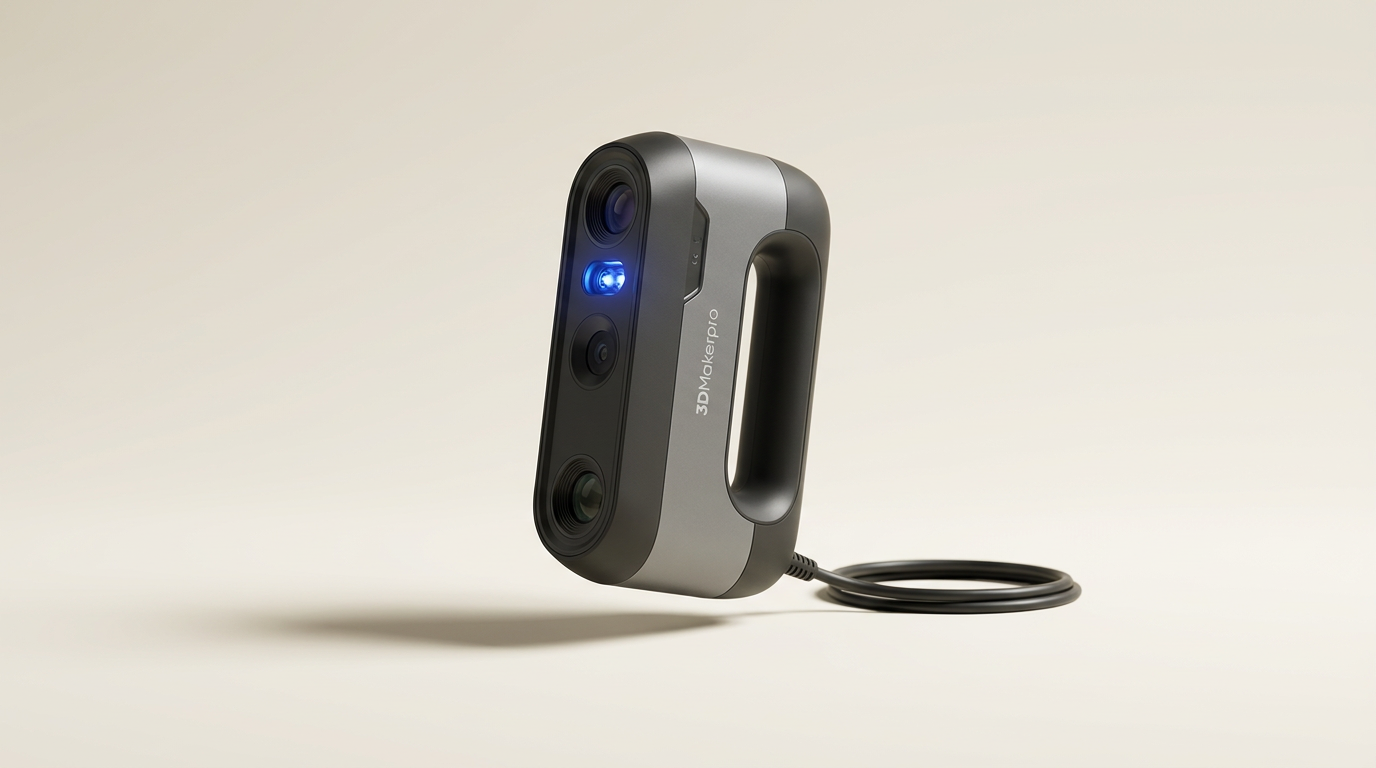
The market for accessible 3D scanning often forces a trade-off: precision for price. The 3DMakerpro Moose Standard challenges this dynamic, positioning itself not just as another handheld scanner, but as a bridge between enthusiast-grade tools and professional workshop equipment. It promises a level of detail typically associated with significantly higher price points, making it an intriguing proposition for those who demand fidelity in their digital models.
While marketing often emphasizes raw specifications, the true test of a 3D scanner lies in its ability to translate those numbers into tangible results. The Moose Standard steps up as a contender for 'detail-driven demographers'-users who prioritize capturing intricate surface geometries over scanning speed or large object capacity. This review dissects whether its claimed accuracy and user experience align with the realities of demanding 3D modeling workflows.
What owners love
- + Captures exceptionally fine surface details and intricate structures
- + Provides professional-grade accuracy at a consumer-friendly price point
- + AI visual tracking enables smooth, marker-free handheld scanning
- + User-friendly setup and integrated JMStudio software
- + Significant performance upgrade over its Lite predecessor
Common complaints
- − Steep learning curve for optimal scanning and processing
- − Multiple attempts often required for successful scan alignment
- − Scan speed is not a primary strength
- − Optional Smart Grip and mobile integration sold separately
Design & Build
The 3DMakerpro Moose Standard presents a compact and ergonomic design conducive to handheld operation. Its form factor allows users to navigate around objects, facilitating capture from various angles, which owners find critical for comprehensive data acquisition. The device integrates blue light technology, a common feature in high-precision scanners, indicating a design focus on accuracy over broad environmental tolerance. The physical build appears robust, supporting its intended use for repeated, detailed scanning tasks. This design choice underscores what we term 'the precision imperative,' where physical form factors are optimized to minimize user-induced error during the crucial data capture phase.
Setup & Ease of Use
Owners consistently report a straightforward setup process, allowing for quick initial deployment. The scanner's core functionality, particularly the AI visual tracking, is noted for enabling marker-free operation, which simplifies the pre-scanning workflow significantly. However, despite these initial conveniences, the path to obtaining high-quality, usable scans introduces a 'skill acquisition gradient.' Users acknowledge a notable learning curve required to master the scanning technique and subsequent data processing. This indicates that while the hardware offers sophisticated capabilities, unlocking its full potential demands practice and familiarity with its operational nuances.
Performance in Real Use
The Moose Standard delivers on its promise of high resolution and precision. Owners confirm the capture of fine surface details, with independent testing verifying measurements close to the stated 0.03mm accuracy. This level of detail is particularly beneficial for small objects and intricate structures. The device's performance represents a substantial improvement over previous models, such as the Moose Lite, suggesting a meaningful refinement in its scanning algorithms and hardware integration. While fast preview renders aid in immediate feedback, a recurring observation is the need for multiple attempts to achieve successful alignment when combining scans, a common challenge in the structured light scanning category that highlights the 'alignment tax' inherent in multi-pass capture.
Software & Ecosystem
The JMStudio software is central to the Moose Standard experience, integrating scanning, editing, and optimization features. Owners find the software user-friendly for general operations, with smooth export capabilities to common modeling programs like OBJ, STL, PLY, and ASC. This broad compatibility streamlines integration into existing 3D pipelines. The software also aids in post-processing by reducing manual mesh editing, leveraging intelligent processing. However, the 'refinement gap' sometimes observed during multi-scan alignment suggests areas for potential improvement in the software's more advanced features, where automation or guidance could be further enhanced to reduce user effort.
Value & Reliability
Priced in the mid-range for 3D scanners, the Moose Standard is lauded for offering professional-grade accuracy at a consumer-friendly price. Several owners describe it as a significant performance upgrade over comparable units, particularly older models from the same brand. The build quality, while not explicitly detailed by all owners, contributes to its perceived reliability, with consistent reports of stable and accurate scanning results. The value proposition here is strong for individuals or small businesses requiring high detail for applications like reverse engineering, quality control of small parts, or creating highly detailed models for digital archiving, without investing well north of $1,000. Its 'performance-to-price ratio' makes it a compelling choice in its segment.
Verdict
Buy - The 3DMakerpro Moose Standard delivers exceptional detail and accuracy at a highly competitive price point for serious hobbyists and small workshop users.
This scanner is an excellent fit for users who prioritize capturing intricate details on small to medium-sized objects and are willing to invest time in mastering the scanning and processing workflow. Its precision makes it suitable for fine art replication, product design iterations, or detailed archival projects, especially when budget constraints preclude purchasing scanners in the thousands of dollars range. Those needing to scan very large objects quickly or who require a completely plug-and-play experience without any learning curve should consider alternative solutions or adjust expectations.
The Moose Standard successfully carves out a niche in the expanding 3D scanning landscape. It effectively democratizes high-fidelity 3D capture, demonstrating that precise volumetric understanding no longer requires a prohibitive investment. Its most compelling attribute is its challenge to the established 'accuracy-cost curve,' pushing advanced capabilities into a more accessible price bracket and empowering a new generation of detail-driven makers.
FAQ
More 3D Scanners reviews
Creality 8-inch Rotating Turntable: A Solid Scanner Accessory

Generic 12 Piece Multi-Angle Markers Review: Essential 3D Scanning Dots
EinScan SE V2 Review: Precision for Dedicated 3D Modelers
Honeywell Voyager 1452g Review: A Kit That Falls Short
Matter and Form Three Review: Precision 3D Scanning Reimagined
3DMakerpro Scanner Tripod Holder Review: A Micro-Tripod for Macro Precision
This review is based on real experiences shared by owners in online communities.