
FLASHFORGE Creator 5 Pro Review: Multi-Toolhead Utility
This review is based on real experiences shared by owners in online communities.
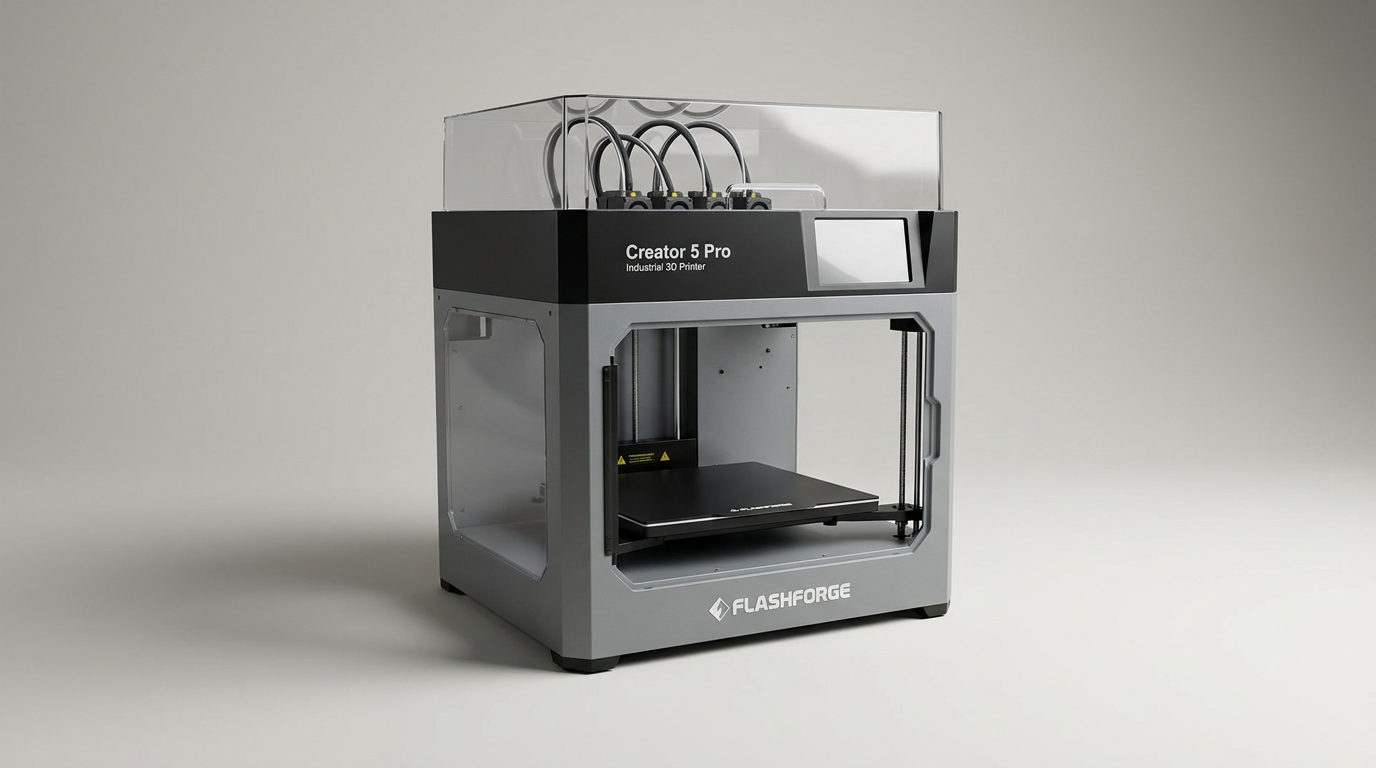
In an additive manufacturing market currently infatuated with single-nozzle multi-color hubs that spit out mountains of plastic purge waste, independent toolhead architecture feels like an overdue return to engineering sanity. The FLASHFORGE Creator 5 Pro targets the exact point where consumer multi-material gimmicks hit their practical limit. By pairing multi-extrusion capability with an actively heated chamber, it cuts out what can be called the purge waste tax, delivering dedicated nozzles that swap without flushing grams of molten resin down a side chute.
Yet transitioning from casual desktop printing to industrial-grade pretensions creates distinct friction points. While Flashforge delivers remarkable structural rigidity and plug-and-play setup right out of the crate, the machine retains several legacy design quirks. Prospective owners must weigh genuine multi-material throughput against physical space limits, noticeable vibration footprints, and an idiosyncratic filament enclosure.
What owners love
- + Eliminates purge waste compared to single-nozzle multi-color systems
- + Actively heated enclosure reliably controls warping on ABS and PETG
- + Ready to print quickly out of the box with automated calibration
- + Sturdy CoreXY chassis with high-grade industrial fit and finish
- + Clean color and material separation with no cross-contamination
Common complaints
- − Internal filament bay is too tight for standard 200mm spools
- − Substantial chassis vibration and motor noise at peak speeds
- − Proprietary replacement nozzles add notable long-term operating costs
- − Flashprint desktop software exhibits occasional network discovery drops
Design & Build
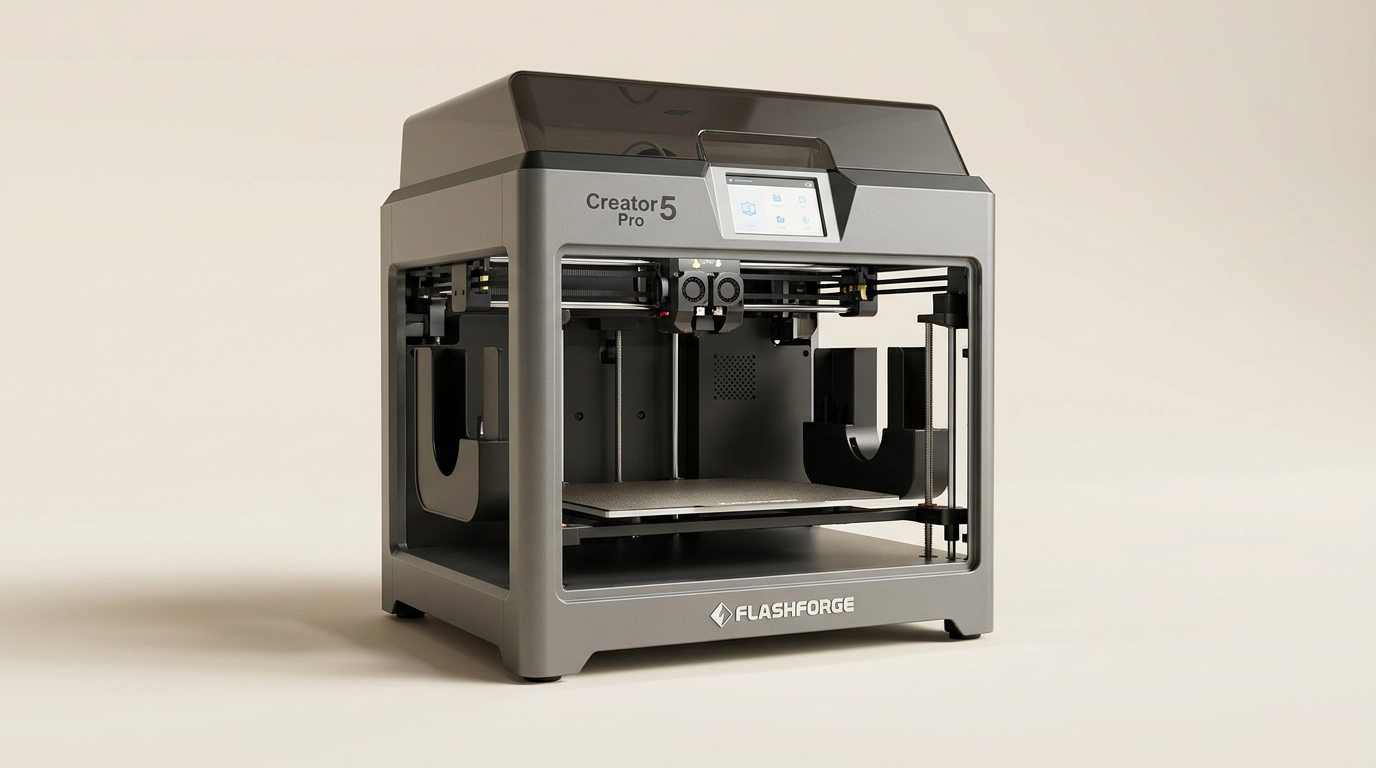
The Creator 5 Pro is built like an appliance intended for workshop benches rather than home office desks. Its rigid metal frame and fully enclosed CoreXY layout provide the thermal stability necessary to hold internal temperatures up to 65C. The HEPA13 filtration and sealed chassis keep drafts out and particulate fumes contained, which is a baseline requirement when running styrene-based polymers. However, the internal layout reveals what can only be described as the internal spool bottleneck. The onboard filament cabinet is restricted to roughly 180mm spool diameters. Standard 1-kilogram spools measure closer to 200mm, forcing owners to either source undersized spools, print external brackets, or run raw filament through drilled enclosure ports with the lid cracked open.
Setup & Ease of Use
Getting the machine operational takes very little friction, defying the historic reputation of complex multi-head printers. Unboxing to first extrusion routinely takes less than fifteen minutes, aided by intuitive touchscreen prompts and a dependable multi-point leveling routine. The PEI magnetic spring sheet yields consistent first-layer squish and effortless part removal once cooled. Where the onboarding experience stumbles is workflow continuity: Flashforge relies on its Flashprint desktop software, which lacks support for mobile operating systems like iPadOS. Families or educational users expecting a streamlined, tablet-driven experience will find themselves tethered to a dedicated laptop or desktop computer.
Performance in Real Use
In everyday production, the mechanical design demonstrates what we term the waste-free color dividend. When executing multi-color or dual-material prints, such as combining rigid structural parts with soluble supports or accent colors, the Creator 5 Pro swaps active nozzles mechanically instead of conducting extensive purging cycles. This saves dozens of print hours and substantial filament weight on complex jobs. Surface finish across PLA, PETG, and engineering filaments is crisp, provided material is adequately pre-dried. The main operational compromise is acoustic: at maximum acceleration, structural resonance creates severe vibrations. Several owners report needing to run the printer in a dedicated quiet mode or isolate it outside living quarters to avoid intrusive noise.
Software & Ecosystem
Flashprint remains a competent, if slightly utilitarian, slicing package. It prepares models cleanly, generates functional support structures, and sends jobs over the local network with minimal fuss once configured. However, network discovery over Wi-Fi can be erratic, requiring occasional IP re-entry or reliance on the rear wired Ethernet port and USB drive transfers. The ecosystem also exerts pressure on consumables. Flashforge utilizes specialized quick-swap nozzle assemblies that make nozzle changes painless, but heavy production users report frequent nozzle replacements that represent a continuing operational expense over standard brass V6 components.
Value & Reliability
Occupying a price tier around $1,000, the Creator 5 Pro straddles the divide between high-end hobbyist bedslingers and five-figure industrial machines. For workshops printing functional ABS, ASA, or multi-filament production prototypes, the cost justification is immediate: the lack of purge waste and the inclusion of a truly heated chamber pay for themselves in reduced failure rates and lower scrap tonnage. The primary longevity warning centers on operating overhead. Between proprietary nozzles and the necessity of rigging external spool rollers, buyers must accept that running this machine requires an industrial mindset rather than an appliance-grade hands-off expectation.
Verdict
Buy - A capable multi-material workhorse that prioritizes functional efficiency over single-nozzle convenience.
This printer is tailor-made for functional fabricators, design studios, and technical hobbyists who regularly handle engineering resins like ABS and PETG, or those who require true multi-material separation without throwing spools of plastic away in purge towers. It represents high-throughput manufacturing value in the sub-thousand-dollar category.
Skip it if you need a whisper-quiet machine for a bedroom workstation, require a turnkey mobile slicing app, or refuse to modify filament feeds to accommodate standard off-the-shelf 1-kilogram spools.
The Creator 5 Pro proves that the future of multi-material printing belongs to dedicated toolheads rather than wasteful single-nozzle purging tricks, even if Flashforge still clings to an archaic, undersized internal spool cabinet.
FAQ
More 3D Printers reviews
QIDI Q2 3D Printer Review: High-Temp Power at a Consumer Price
Flashforge Adventurer 5M Smooth PC Plate Review
FLASHFORGE Creator 5 Pro Review: Multi-Toolhead Efficiency
HP OfficeJet Pro 9135 Review: Two Trays and a Tight Leash
Flashforge Creator 5 Pro Review: Multi-Material Toolchanger
Bambu Lab P2S Combo Review: The 3D Printer Appliance
This review is based on real experiences shared by owners in online communities.