
Anycubic Kobra 3 Max Combo Review: Big Prints, Bigger Headaches?
This review is based on real experiences shared by owners in online communities.
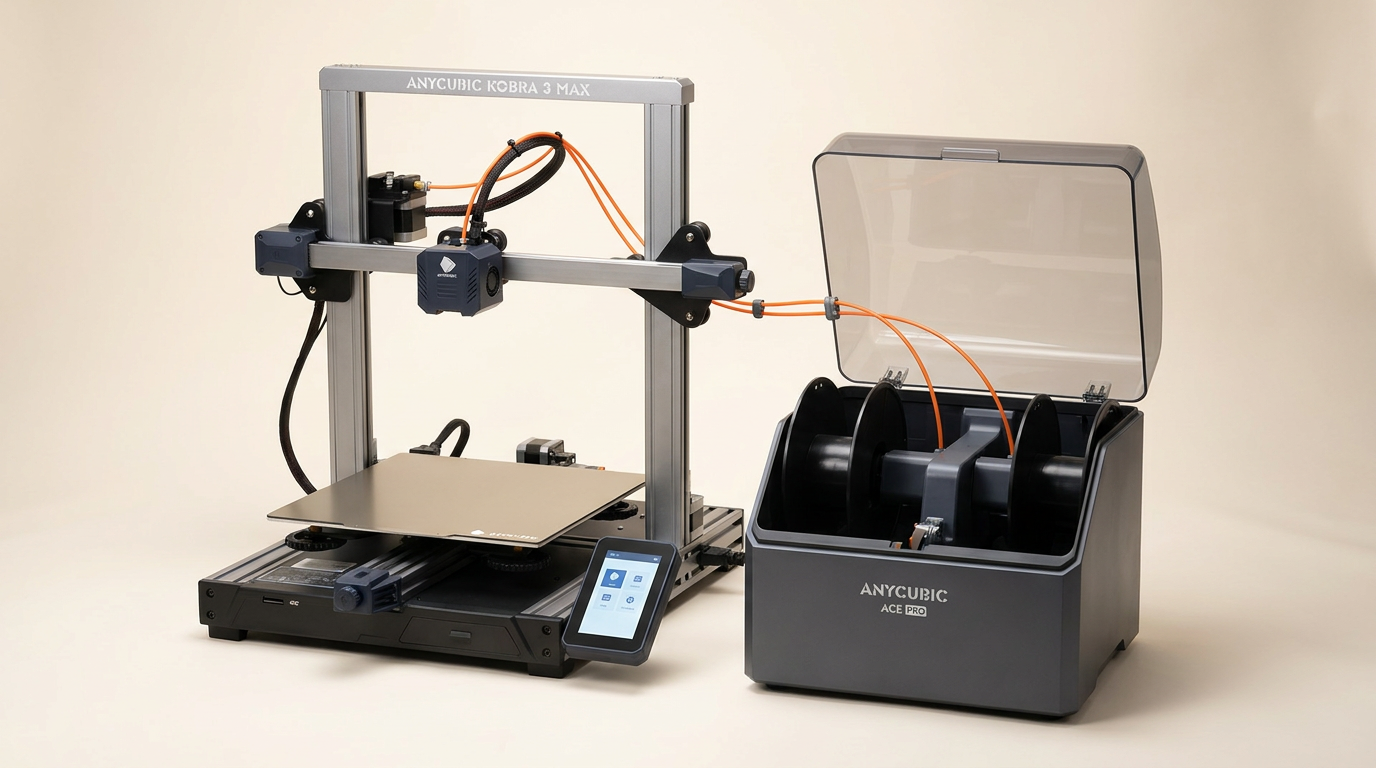
The 3D printing landscape has bifurcated: one path leads to increasingly automated, plug-and-play experiences, while the other doubles down on raw capability, often at the expense of user-friendliness. The Anycubic Kobra 3 Max, with its immense build volume and advertised high speeds, firmly plants itself in the latter camp, catering to a specific kind of maker. It offers a promise of scale that few consumer-grade machines can match, suggesting an era where large-format 3D printing becomes accessible beyond industrial settings.
However, this ambition comes with significant caveats. While marketing highlights its expansive print area and rapid throughput, owner experiences consistently reveal that these features are often locked behind a steep learning curve and, for many, an ongoing battle with reliability. This machine operates on what we term the "Large Print, Large Fiddle" principle: the bigger the print, the more patience and technical intervention it demands.
For those who prioritize sheer size and are prepared to invest substantial time in calibration and troubleshooting, the Kobra 3 Max might represent a tool for ambitious projects. But for users expecting a smooth, consistent workflow for large prints, its reality often falls short of its potential, signaling a product more suited for the dedicated tinkerer than the casual large-scale producer.
What owners love
- + Generous 420x420x500mm build volume for large objects
- + Advertised high print speeds of up to 600mm/s
- + Dual-sided PEI spring steel plate facilitates print removal
- + Filament runout sensor and power outage resume function included
- + Value proposition for its size is appealing to some users
Common complaints
- − Significant reliability issues and frequent print failures
- − Steep learning curve and extensive calibration required
- − Poor customer support response and resolution
- − Maintenance can be complex and frequent
- − Software and documentation quality are subpar
Design & Build
The Anycubic Kobra 3 Max distinguishes itself primarily through its physical footprint. Its 420x420x500mm build volume dominates any workspace, enabling the creation of objects impossible on most desktop printers. The inclusion of an all-metal hotend, rated for up to 300°C, and a dual-sided PEI spring steel plate suggests a design intended for robust performance and ease of use in print adhesion and removal. However, reports indicate that this design does not guarantee durability or trouble-free operation; some owners describe plates becoming gouged quickly, and frequent print head replacements suggest underlying material or design vulnerabilities. The physical size is an undeniable asset, but the components within, at least for some units, do not consistently match the ambition of the overall design, leading to what we call the "Aspirational Build" paradox where theoretical capabilities struggle against real-world material limitations.
Setup & Ease of Use
Initial setup for the Kobra 3 Max is a common point of frustration for many owners. The instruction manual is frequently cited as poorly translated and riddled with errors, complicating the assembly process. The printer's touch interface suffers from similar translation issues, adding friction to basic operation. Unlike machines designed for immediate gratification, this Anycubic model demands significant user intervention. Owners report extensive 'fiddling around with settings' to achieve successful prints. This necessitates a deep understanding of slicer software and calibration procedures, aligning with a common pattern in the large-format budget sector: an expectation that the user will become an expert in machine optimization. This is a "DIY-heavy" product, not a "set-it-and-forget-it" appliance.
Performance in Real Use
The Kobra 3 Max's performance is highly inconsistent, generating both praise and profound dissatisfaction. Some users celebrate its ability to print large items, appreciating the option for multi-material supports and the sheer scale it offers. The advertised 600mm/s print speed, while attractive, proves problematic in practice; owners report that using the fast option often leads to jams and clogs, making the high speed largely theoretical for reliable output. Many successful prints require significant tuning to mitigate issues like table jerking, warping, and layer shifts. A recurring theme is the battle against persistent clogging, with multiple print head replacements being a common, and often temporary, solution. This indicates a "Speed vs. Stability" trade-off where the machine's robust motion system often outpaces its extrusion system's reliability, preventing consistent utilization of its headline speed.
Software & Ecosystem
The software experience with the Kobra 3 Max mirrors the hardware's inconsistencies. Owners mention difficulties with the printer's ability to be located on a local area network, even with direct physical connections. This hinders remote operation and monitoring. The general sentiment is that the software requires considerable user expertise to navigate and optimize. The lack of a robust, intuitive software ecosystem places additional burden on the user, pushing them towards community solutions or extensive self-teaching. This contrasts sharply with printers from other brands that offer more integrated and polished software experiences. The 'open-source burden' here means users must effectively become their own system integrators, debugging not just hardware but also the interface and connectivity.
Value & Reliability
The value proposition of the Kobra 3 Max is intrinsically tied to its reliability, which is a major point of contention. For its size and features, its price point is significantly lower than high-end alternatives. Some owners perceive this as a 'great value for size,' especially if they are already experienced with troubleshooting. However, a substantial number of users report the machine failing within months, citing issues from display malfunctions to persistent clogging and an inability to complete prints. Customer support is consistently described as unresponsive, unhelpful, or slow, making warranty claims and technical assistance difficult. This leads to a 'Hidden Cost of Fiddling': while the initial purchase price is attractive, the time investment, replacement parts (often unassisted by support), and missed print opportunities accumulate into a much higher total cost of ownership. The printer's longevity and consistent output remain a gamble for many.
Verdict
Hold Off - Persistent reliability issues and a steep operational curve make this printer a risky investment for most users.
This printer is best suited for experienced 3D printing enthusiasts or professional tinkerers who specifically require a massive build volume and are prepared for extensive calibration, maintenance, and troubleshooting. If you enjoy the challenge of dialing in a machine and possess the technical knowledge to diagnose and fix recurring problems, and you find a large printer at a price point under $600 appealing, it might serve as a project platform. Users prioritizing cost over consistent results may also find a niche here.
However, those seeking a reliable, out-of-the-box experience, or individuals new to large-format printing, should look elsewhere. The recurring reports of print failures, poor software, and unresponsive customer support make it a frustrating proposition for anyone expecting dependable output for their investment. Do not consider this machine if your projects demand consistent uptime or if you lack the patience and technical skill for ongoing mechanical and software adjustments.
The Anycubic Kobra 3 Max embodies the 'Ambition Gap' prevalent in parts of the budget large-format 3D printing market. It aspires to high performance and massive scale but often falters in fundamental reliability and user support. This creates a challenging ownership experience where the potential for grand prints is frequently undermined by an ongoing requirement for debugging, effectively trading a lower upfront cost for a higher long-term expenditure of time and patience. It highlights that in 3D printing, sheer build volume without robust engineering and support infrastructure is often a false economy.
FAQ
More 3D Printers reviews
Bambu Lab P1S Combo Review: The 3D Printer for the Making Generation
ANYCUBIC Wash and Cure 3.0 Review: A Post-Processing Necessity
FLASHFORGE Adventurer 5M Pro Review: The Enclosed Beginner 3D Printer
Sovol SV08 Max Review: A Colossal CoreXY Printer for the Committed
Refresh Sports Boomerang for Kids Review: Fun Returns, But at What Cost?
ANYCUBIC Photon Mono 4 & Wash & Cure 3.0 Review
This review is based on real experiences shared by owners in online communities.