
ANYCUBIC PLA Filament Refill Review: Smart Spooling
This review is based on real experiences shared by owners in online communities.
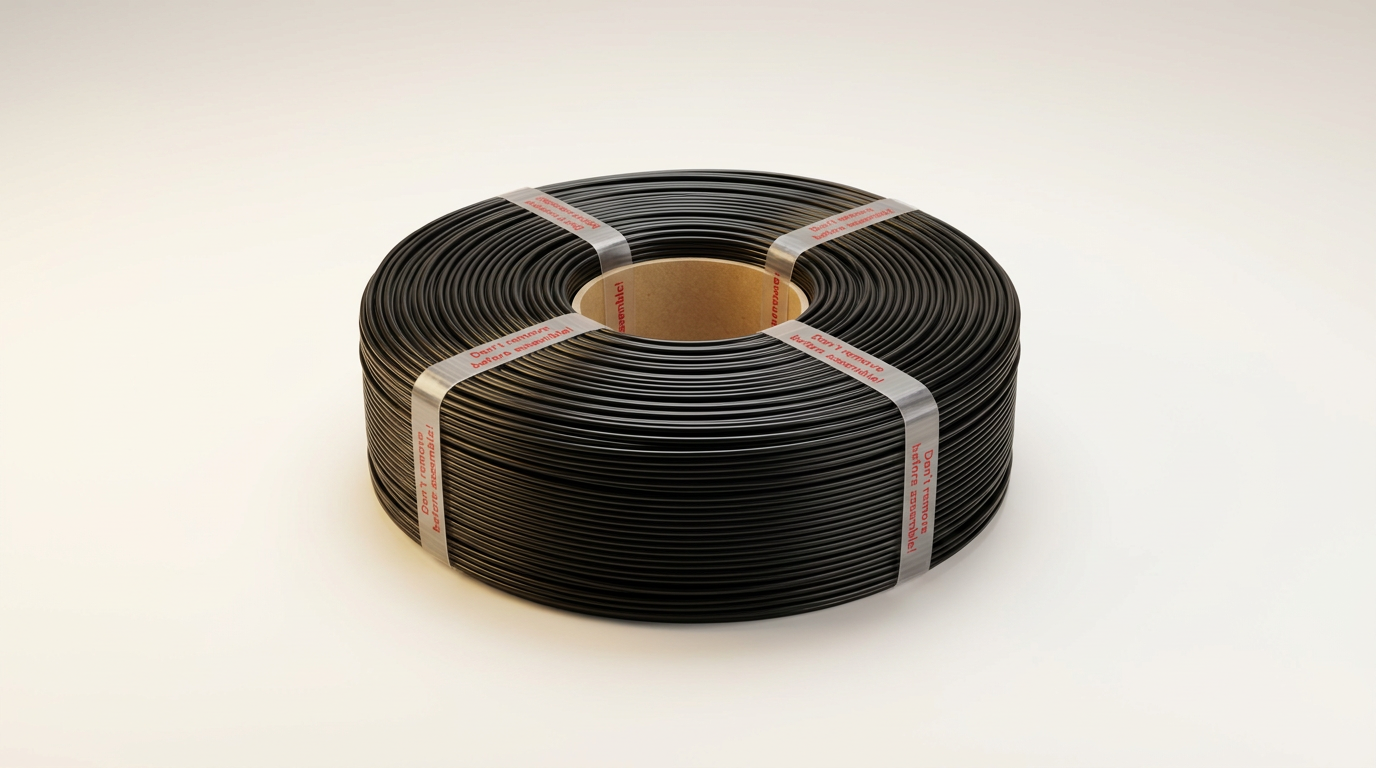
The spool-less filament movement promised to eliminate single-use plastic waste while passing manufacturing savings directly to makers. In reality, the budget refill market often exposes buyers to what we call the transfer tax: saving a couple of dollars upfront in exchange for precarious coil re-spooling, loose outer wraps, and sudden mid-print snags. Anycubic's 1.75mm PLA Refill challenges that friction by attempting to bridge proprietary multi-material hardware with open-source master spool ecosystems.
Designed to slide directly onto reusable spool flanges, this spool-less 1kg coil arrives vacuum-sealed with internal strapping and integrated RFID tags intended for Anycubic's ACE Pro multi-material unit. Yet its true marketplace footprint is far more universal. Makers running Bambu Lab AMS units and standard open-frame beds are routinely adopting this material as a low-cost, bulk workhorse for rapid prototyping and functional parts.
Across extensive production hours reported by owners, this PLA demonstrates clean dimensional stability and dependable layer cohesion, but not without compromises. From slightly desaturated pigmentation to the ever-present hazard of loose loops slipping off the cardboard core during mounting, this refill is a practical tool that rewards mechanical discipline over hurried loading.
What owners love
- + Tight dimensional stability within advertised 0.02mm tolerance
- + Flawless fit on Bambu Lab reusable spools and Anycubic master reels
- + Dual RFID chips included for automatic material detection on ACE Pro
- + Exceptional first-layer adhesion even at modest 45C bed temperatures
- + Clean satin finish that effectively hides layer stepping
Common complaints
- − Vulnerable to loose-wrap jams if retention straps are cut too early
- − Black pigment leans toward a soft charcoal rather than deep jet black
- − Volatile marketplace pricing occasionally erodes the refill discount
Design & Build
The Anycubic PLA Refill arrives as an unsupported 1kg toroidal coil bound by plastic retention straps around a central cardboard sleeve. A small notch inside the core aligns with corresponding keys on Anycubic reusable reels, preventing the spool from slipping under high rotational torque. Build quality is immediately evident in the line consistency: users using digital calipers consistently measure tolerances well within the 0.02mm margin, preventing erratic volumetric flow in standard 0.4mm nozzles.
The filament's optical profile, however, exhibits what can be described as charcoal drift. Instead of producing an obsidian or deep gloss jet-black part, this formulation cures to a matte, dark-slate charcoal. While this subdued tone works remarkably well to mask minor layer lines on mechanical enclosures, print-farm operators matching precise brand colors or aesthetic figurines should note that this is not an ink-black material.
Setup & Ease of Use
Refill systems succeed or fail entirely on spool transfer ergonomics, and this is where Anycubic's offering demands strict procedural discipline. Transferring the spool involves securing the coil between master flanges before severing the factory tie bands. Those who rush the process encounter the core-drop penalty: outer loops can slough off the sides of the cardboard core, dropping between the filament pack and the spool wall.
For makers who follow proper procedure, the coil locks cleanly onto standard Anycubic master spools, printable Makeronline hubs, and notably, Bambu Lab reusable spool flanges. Once firmly clamped and freed of its bindings, the spool feeds smoothly off the perimeter without binding or edge-snagging, provided the initial seating was square.
Performance in Real Use
On the print bed, Anycubic PLA delivers dependable, fuss-free mechanical performance. Bed adhesion stands out as a genuine strength; the formulation bonds firmly to textured PEI and cool-plate surfaces at bed temperatures as low as 45C, significantly curbing bottom-corner warping on large-footprint models. Once cooled, parts release predictably without taking chunks of coating with them.
Extrusion consistency remains steady across typical hobbyist and high-speed flow profiles. Owners report zero clogging, bubbling, or inconsistent stringing when operating between 200C and 215C. Print speed does dictate the surface luster: pushed fast on high-acceleration toolheads, the filament develops an even satin-matte texture, while slower perimeters pick up a subtle gloss. Dimensional accuracy holds up under scrutiny, ensuring push-fit functional prints assemble without aggressive filing.
Software & Ecosystem
Anycubic targets its own hardware family by packing dual RFID tags with each refill. When slotted into the Anycubic ACE Pro multi-material box, the unit immediately reads the filament profile, tracking color identification, remaining capacity, and recommended thermal ranges without manual slicer configuration. For owners invested in that closed environment, the experience matches the seamlessness pioneered by market leaders.
Yet this refill also thrives in an unexpected niche: the multi-material paradox, where makers use Anycubic consumables to feed competing Bambu Lab AMS units. Because the inner diameter precisely matches Bambu spool dimensions, users can drop this budget refill onto Bambu hardware, bypass the non-functional RFID on that platform, select a generic PLA profile in OrcaSlicer, and achieve reliable, uninterrupted feeds.
Value & Reliability
Priced comfortably in the budget tier under $20, this refill delivers substantial consumable economy, particularly for print farms churning through high-volume prototyping. Eliminating the plastic reel keeps both shipping weight and workshop trash bins clear. However, marketplace algorithms create occasional price distortions where refill coils temporarily match or exceed the cost of fully spooled filament. Savvy buyers will want to track sales.
Reliability remains heavily correlated with the winding quality of individual batches. While the vast majority of coils run smoothly from first meter to last, several verified owners have reported loose factory winding where overlapping strands dig into lower layers, creating intermittent snags. Inspection during the initial load is critical to ensure the roll does not bind during unattended overnight jobs.
Verdict
Buy - A reliable, high-yield PLA refill that delivers excellent print consistency if you handle the spool transfer with care.
This material is best suited for high-volume makers, workshop fabricators, and print farm operators running reusable spools on Anycubic ACE Pro or Bambu Lab AMS setups. The dimensional stability and surface finish easily match standard spool-bound budget filaments while cutting down on discarded plastic. If your primary goal is affordable, structural, or prototyping utility, it makes complete sense.
Skip this refill if you demand a deep, piano-grade jet black, as the pigmentation leans distinctly charcoal. Anyone who lacks the patience to carefully lock down master spool flanges before cutting retention bands should also look elsewhere; a hasty transfer will quickly ruin a spool with side-binding snags.
The Anycubic PLA refill exposes a core reality of modern additive manufacturing: while multi-material hardware has become remarkably automated, the consumable supply chain remains mechanically analog. Refills are not a hands-off miracle; they are a direct trade of three minutes of manual assembly for lower costs and less landfill waste. Treat the installation as a precise shop procedure, and this coil will quietly churn out dependable parts for pennies on the hour.
FAQ
More 3D Printing Supplies reviews
ALECPEA 3D Print Glue Review: Precision Bonding for Makers
EONO3D Matte 95A TPU Review: The Layer-Hiding Flexible
SUNLU Matte Bone White PLA Filament Review: A Budget Workhorse
Fuitnerd Filament Storage Box: An Accessible Dry Storage Solution
SUNLU PLA+2.0 Filament Refill: An Unspooled Advantage for 3D Printing
Polymaker Panchroma PLA Filament Review: Consistent Prints, Vivid Colors
This review is based on real experiences shared by owners in online communities.