
Topacme 3D Relief Art Pen Review: Popcorn Pen Reality Check
By AValidReview. An AI-assisted summary of customer feedback, not a hands-on test.
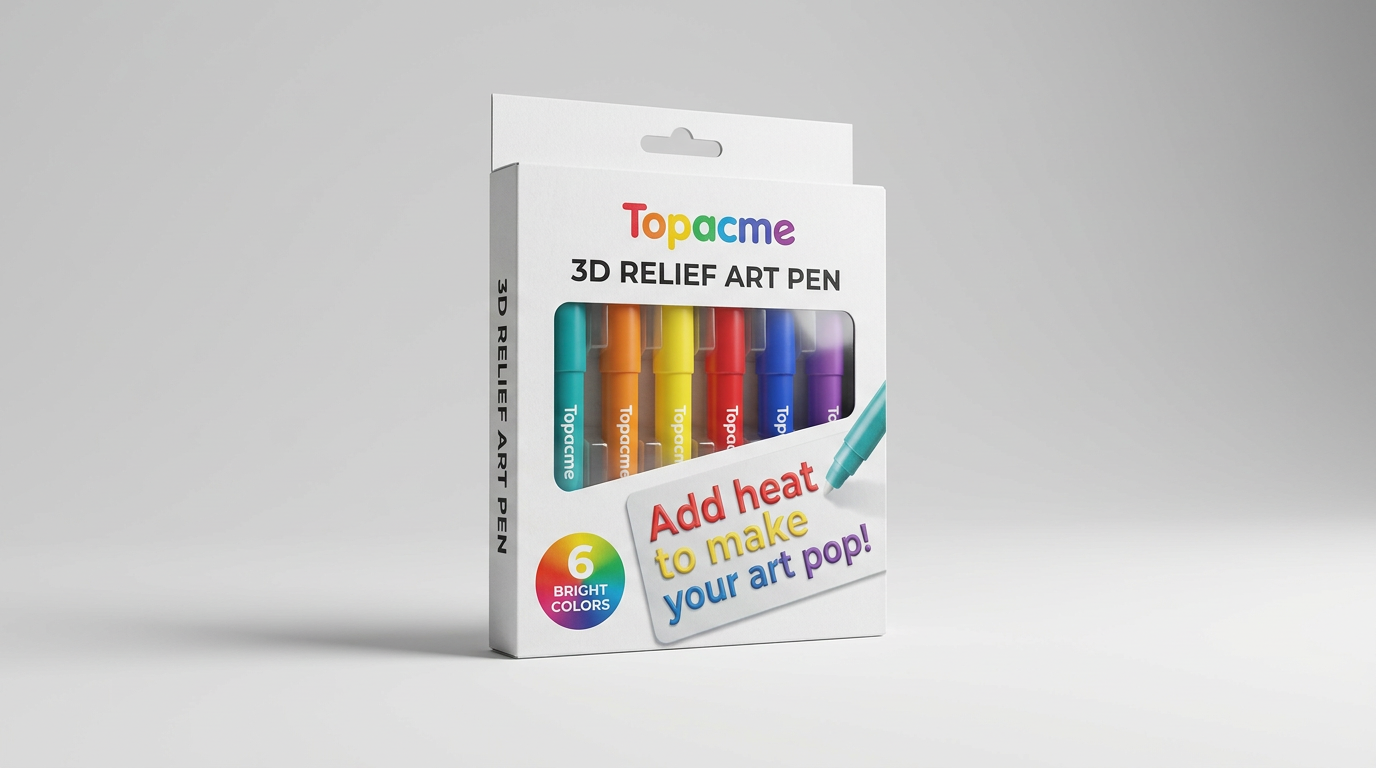
Online marketplaces have birthed an irritating phenomenon: the algorithmic Trojan horse. Products adopt technical taxonomy to harvest search intent, landing novelty stationery squarely inside serious industrial categories. The Topacme 3D Relief Art Pen is listed under additive manufacturing and 3D printing tools, but it shares nothing with thermoplastic extrusion pens. It is a set of six miniature squeeze tubes filled with thermal-reactive craft ink, marketed on the promise of transforming ordinary ink drawings into puffy, popcorn-style textured reliefs via a standard household hairdryer.
The premise leans heavily on short-form viral craft videos, where liquid lines magically bubble into foam within seconds. What buyers actually unbox, however, exposes the thermal activation gap: the massive divide between chemically optimized demonstration clips and the reality of heating stubborn craft emulsions on a kitchen table. Rather than an accessible gateway to physical texturing, this set delivers acute frustration.
While the ink functions as an ordinary liquid marker with reasonable adhesion on porous stock, its central selling point is almost entirely broken. Evaluated against its core promise of delivering dimensional relief art, the Topacme set fails to justify even its budget under-$20 asking price.
What owners love
- + Adheres cleanly to paper and cardstock without premature peeling
- + Bright neon color selection inside the pack
- + Washable water-based formulation simplifies cleanup
- + Ultra-compact footprint for travel craft bags
Common complaints
- − Consistently fails to produce the advertised 3D puffy expansion
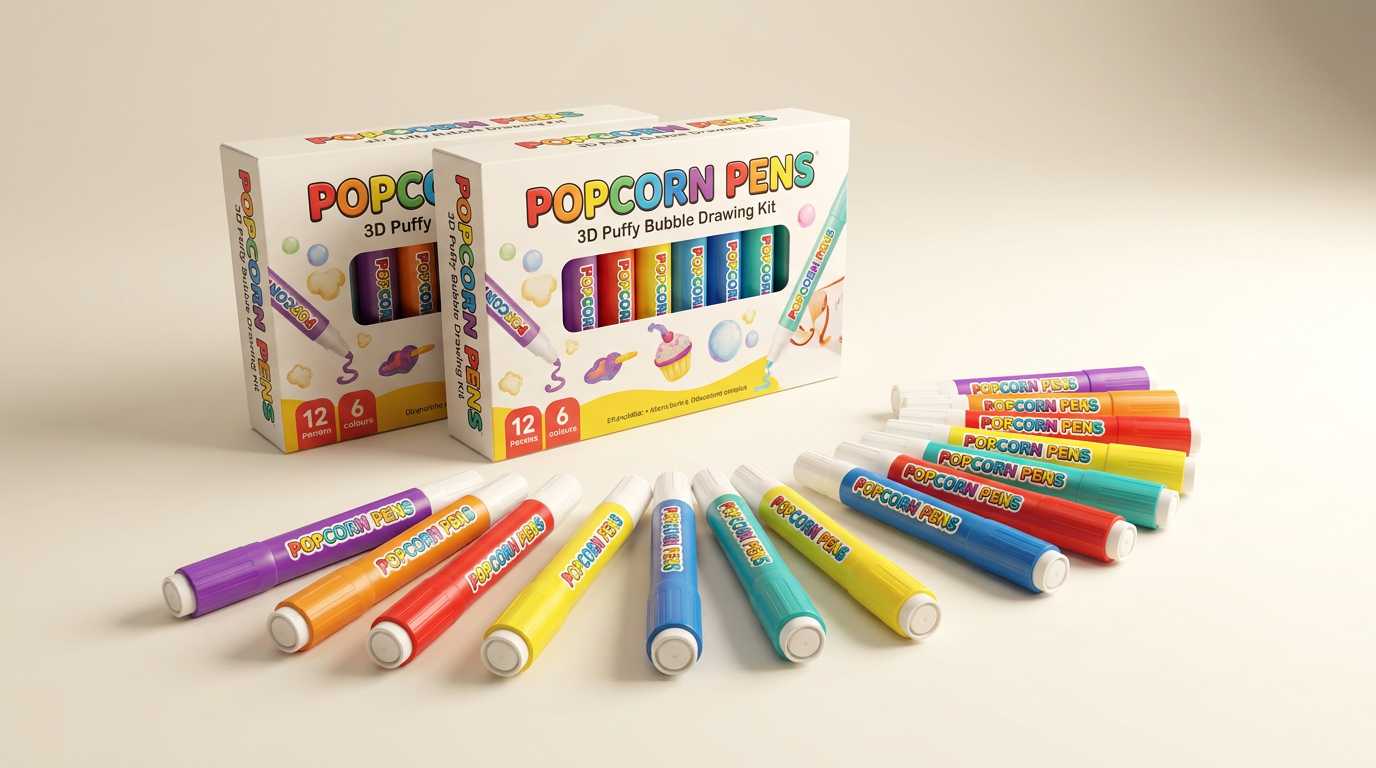
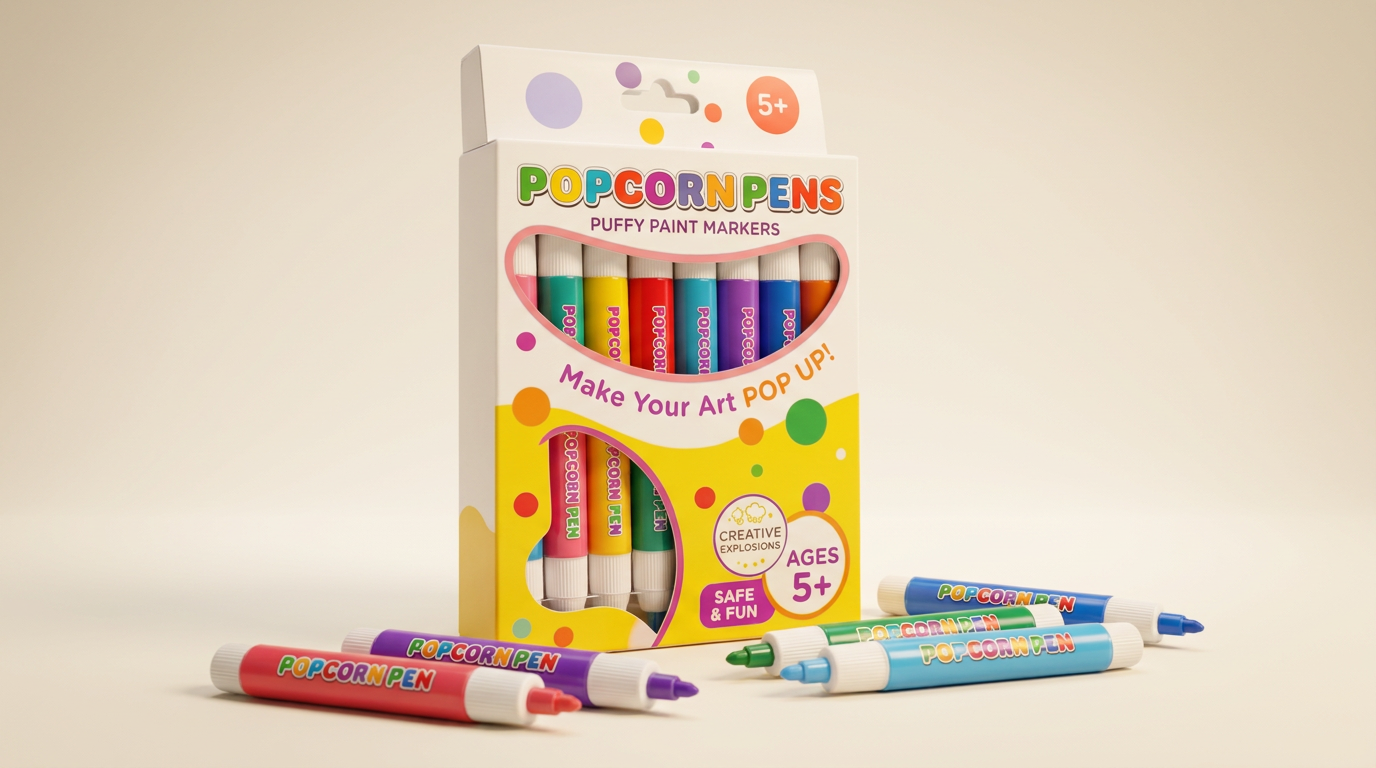
- − Physical pen volume is vastly smaller than marketing images depict
- − Demands prolonged hairdryer heating with negligible visual payoff
- − Misleading product positioning creates false technical expectations
Design & Build
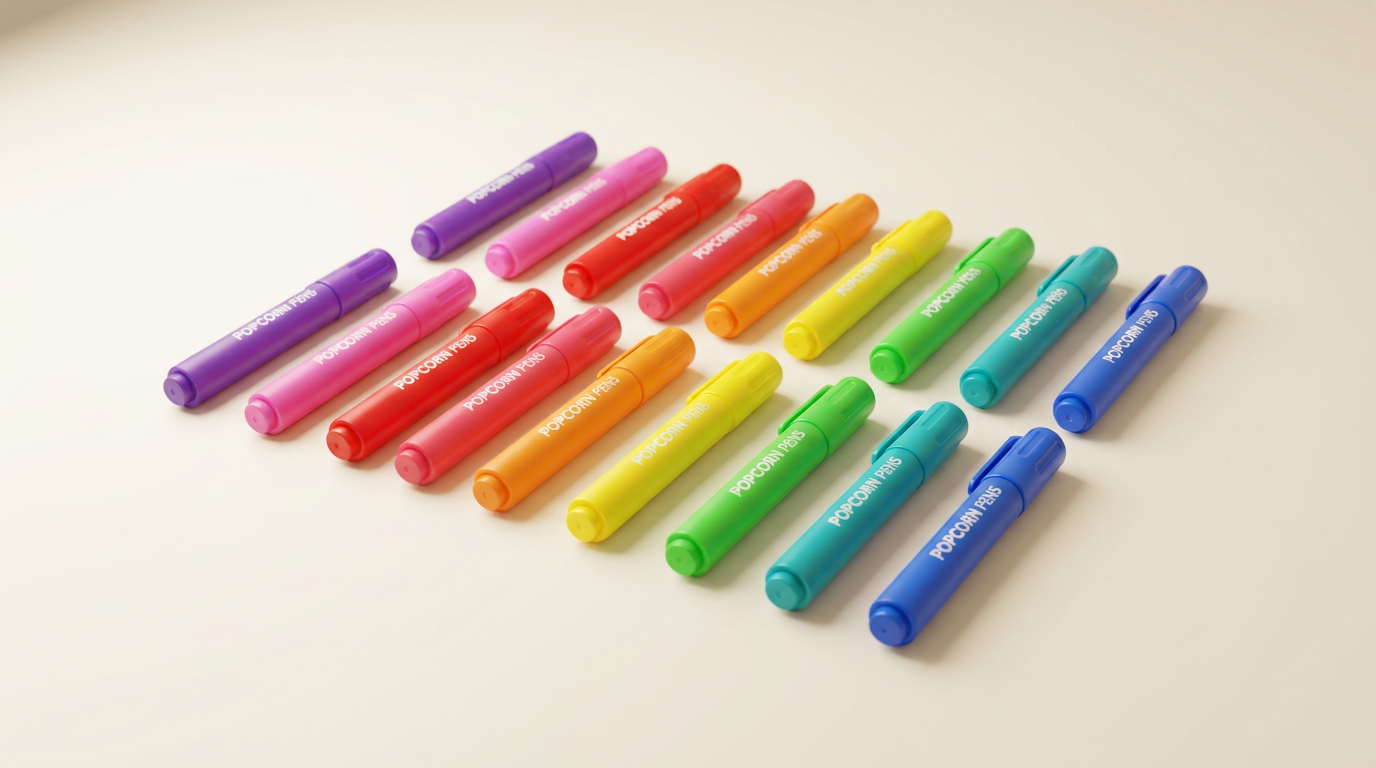
The Topacme set consists of six plastic squeeze markers, each capped with a narrow dispensing nozzle. Buyers immediately encounter scale disillusionment upon opening the parcel. Promotional renders suggest substantial markers suitable for sustained grip, yet the physical barrels are diminutive, containing minimal ink reserves. The plastic walls require firm manual pressure to evacuate the fluid, which hampers consistent line weight. For young children, modulating this pressure while guiding a fine tip across paper proves physically awkward. The tips themselves do not clog easily out of the box, but the small reservoir volume means a single ambitious drawing can deplete a color entirely.
Setup & Ease of Use
Operational setup seems straightforward on paper: draw a design, retrieve a household hairdryer, and apply concentrated heat for roughly two minutes until the chemical blowing agents expand the pigment. In practice, this process introduces significant operational friction. Blown air from a typical 1800-watt dryer tends to flutter lightweight paper across the workspace before thermal transfer occurs, requiring users to tape down or weigh their canvas. More critically, the two-minute heating cycle demands patience that yields no perceptible payoff. While the instructions are simple, the workflow feels disproportionately fussy for what should be an intuitive children's coloring tool.
Performance in Real Use
Performance reveals the core defect of the product. Multiple verified owners report that following the instructions to the letter yields zero three-dimensional swelling. The applied lines do not puff into popcorn textures; instead, they simply dry flat or develop a slightly tacky, glossy film. The underlying chemistry relies on heat-sensitive blowing agents that clearly require thermal tolerances ordinary domestic dryers cannot safely achieve without scorching the substrate. On the rare occasion that the medium stays anchored without peeling, it acts merely as a standard wet paint marker. When a tool fails to deliver the singular sensory feature displayed on its packaging, it ceases to be an artistic medium and becomes an exercise in disappointment.
Software & Ecosystem
Because these pens are categorially misplaced under additive manufacturing, buyers must understand that no software, motors, heated nozzles, or digital ecosystems exist here. There is no USB charging, thermal regulation circuit, or filament compatibility. The Topacme pen is an entirely manual chemical craft product masquerading as maker hardware. Its presence in tech-adjacent search results reflects aggressive search term stuffing rather than functional capability. Buyers seeking authentic freehand 3D deposition should look strictly at legitimate filament extruders from established maker brands, which rely on melted plastic rather than evaporating water-based emulsions.
Value & Reliability
Priced under $20, the Topacme set seems like an inconsequential impulse buy, but low absolute cost does not equal good value. The value proposition evaporates entirely when the central functional claim fails. What remains is a six-pack of sub-miniature paint tubes with questionable volume and unreliable output. While the ink is relatively washable and grips cardstock decently, standard dimensional fabric paints or traditional puffy markers from heritage art brands deliver far superior reliability for similar or lower outlay. The overwhelming owner sentiment categorizes this set as an outright waste of funds, a verdict reinforced by its mechanical deficiencies and misleading presentation.
Verdict
Stay Away - Fails completely to produce the advertised puffy 3D effect while delivering miniature, underfilled pens.
This product is not recommended for parents, crafters, or model makers. Those hoping to create raised tactile greeting cards, scrapbooks, or educational models will only find flat, dried lines and wasted effort. If you need true freehand dimensional creation, invest in an authentic entry-level 3D printing pen that uses PLA filament; if you want textured paper crafts, buy traditional dimensional acrylic fabric paint from a known art supplier.
Skip this set entirely. The Topacme art pen thrives exclusively on the viral allure of time-lapse video chemistry that domestic tools cannot replicate. It represents the worst impulses of search-optimized novelty manufacturing: an unworkable chemical formulation packaged in miniature hardware, banking on a price point so low that most disappointed buyers will not bother filing a return.
FAQ
More 3D Printing Pens reviews
This review is based on real experiences shared by owners in online communities.