
3DMakerpro Seal Lite Review: Precision at a Strict Distance
By AValidReview. An AI-assisted summary of customer feedback, not a hands-on test.
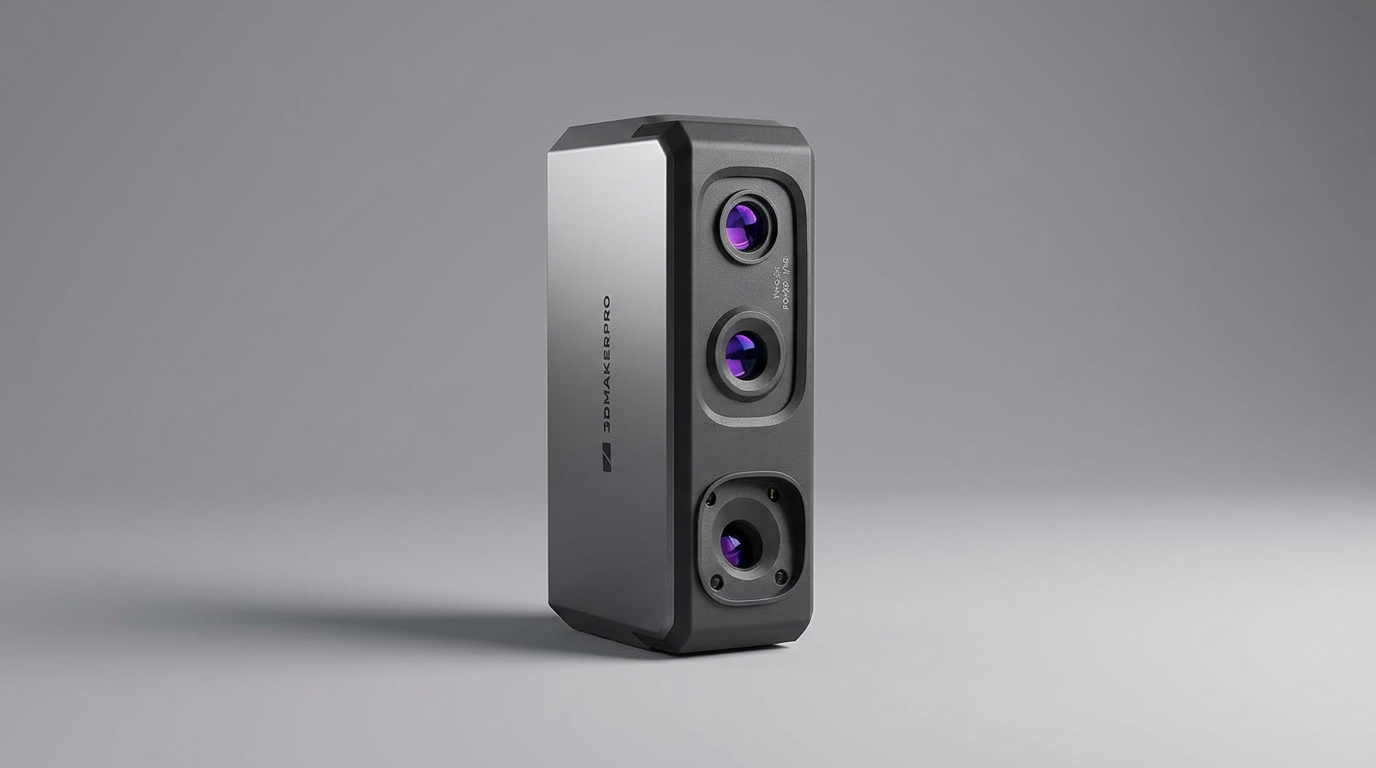
Most entry-level 3D scanners promise hand-guided freedom but deliver muddy digital meshes. The 3DMakerpro Seal Lite takes the opposite approach. It functions less like a general-purpose camera and more like a dedicated tabletop optical gauge. The device addresses the desktop precision-envelope dilemma: sacrificing wide-area flexibility to capture minute mechanical contours on items the size of a key fob or a carburetor jet.
In the roughly $400 segment, blue-light structured projection was virtually unheard of until recently. By utilizing shorter light wavelengths, the Seal Lite targets makers and repair technicians who need accurate STL files for 3D printing rather than low-resolution digital souvenirs. The included package bundles a mini tripod and motorized turntable, signaling that 3DMakerpro expects this hardware to operate as an anchored desktop station rather than a run-and-gun field scanner.
That tighter optical focus introduces strict operating boundaries. Users quickly run into what we call the focal corridor, a razor-thin working distance where a few millimeters of drift can cause tracking to drop entirely. Combined with real-time software processing that punishes modest computers, the Seal Lite proves to be a capable instrument that demands deliberate setup and patient technique.
What owners love
- + Sharp edge definition and fine contour resolution on small components
- + Complete desktop bundle with included turntable and tripod
- + Compact, lightweight housing that stores easily
- + Export pipelines directly output print-ready OBJ and STL formats
- + Blue-light LED projection outperforms standard white light on tiny features
Common complaints
- − Strict working distance window causes frequent tracking loss for novices
- − High compute overhead causes severe interface lag on modest laptops
- − Monochrome sensor captures geometric data only, lacking color texture
- − Dark, glossy, or transparent materials require temporary dulling spray
Design & Build
The Seal Lite makes no attempt to feel like heavy industrial tooling. Constructed from lightweight plastic, the scanner weighs very little in the hand, which keeps fatigue low during manual passes. However, its featherweight construction also means it lacks the solid, inert feel of metal-bodied measurement tools. The compact chassis is an asset on crowded workbenches, easily packing into a small gear bag when not in use.
The real strength of the physical design lies in its deployment as a fixed workstation. By attaching the unit to the bundled mini tripod and pairing it with the automated turntable, you eliminate the micro-tremors inherent to handheld operation. The physical ports and included cabling are straightforward, though running heavy USB leads to a tiny scanner head on a small tripod requires careful cable routing to prevent tipping.
Setup & Ease of Use
Getting the Seal Lite ready on a desk takes five minutes, but learning to maintain a usable tracking lock takes hours. This is where many users encounter the focal corridor. The optical system operates strictly within a 180mm to 280mm depth envelope. When tracking an object, moving just a fraction of an inch too close triggers an immediate distance warning, while easing back slightly can sever tracking entirely.
For beginners accustomed to smartphone LiDAR or forgiving wide-angle scanners, this tight tolerance feels jarring. The handheld mode demands the steady cadence of a surgeon. In practice, the turntable setup is not merely an optional convenience; it is a functional requirement for consistent capture. Once the scanner is locked down on its tripod at the exact prescribed distance, automated rotation removes operator error and transforms an otherwise frustrating calibration dance into a predictable workflow.
Performance in Real Use
Where the Seal Lite justifies its learning curve is in surface fidelity. The blue LED structured light captures crisp bevels, recessed screw holes, and delicate mechanical ribs that diffuse white-light scanners routinely turn into rounded blobs. For automotive fasteners, replacement brackets, and model components within the 10mm to 300mm envelope, the resulting mesh density provides a functional foundation for CAD reproduction.
Physics still applies, however. The optical prep imperative remains an inescapable hurdle: the blue light bounces unpredictably off dark resins, chrome finishes, and glossy plastics. Owners routinely note that attempting to scan an untreated shiny black object yields dropped frames or incomplete point clouds. Applying a quick mist of specialized 3D scanning spray or dry shampoo instantly resolves tracking, turning problematic reflective surfaces into readable matte targets. Handheld scanning speed runs at 10 frames per second, which rewards slow, deliberate sweeps rather than brisk passes.
Software & Ecosystem
The hardware relies on 3DMakerpro's proprietary JMStudio software for data processing, alignment, and mesh generation. The application includes valuable baseline utilities, such as visual tracking cues, automatic registration across multiple rotations, and native export options for STL, OBJ, and PLY files. The user interface is navigable once you understand its conventions, but it imposes a heavy host-system tax.
Running real-time spatial reconstruction at 0.02mm rated accuracy demands substantial compute power. Users operating on standard office laptops or systems with integrated graphics encounter severe latency, dropped frames, and frozen previews. To achieve the fluid tracking advertised by the manufacturer, your workstation needs a capable dedicated GPU and ample system memory. JMStudio handles the geometry cleanly when fed sufficient horsepower, but the software will quickly expose the bottlenecks of budget PCs.
Value & Reliability
Priced in the $400 range, the Seal Lite occupies an interesting middle ground in additive manufacturing tools. It avoids the four-figure cost barrier of professional metrology rigs while offering noticeably tighter detail resolution than typical all-in-one hobby scanners. Including the turntable and desktop mount in the base purchase saves buyers from having to source secondary accessories.
The trade-offs reflect its price tier. The Lite version omits color capture, rendering it purely a dimensional geometry scanner rather than a full-color asset digitizer for game engines. Furthermore, the reliance on plastic casing and sensitive alignment parameters means the tool must be handled with care. As an affordable bridge into functional reverse engineering, its value is high, provided buyers treat it as an optical precision tool rather than an automated toy.
Verdict
Consider - High-detail small-part capture at an accessible price, undermined by a punishing focal window and steep PC requirements.
The 3DMakerpro Seal Lite is built specifically for 3D printing hobbyists, engineers, and mechanics who need to reverse-engineer small mechanical components without spending thousands of dollars. If your projects involve broken plastic gears, automotive clips, or detailed tabletop miniatures, and you own a desktop PC with a dedicated graphics card, this kit delivers exceptional geometric fidelity once locked onto its turntable.
You should skip this unit if you need to capture full-size furniture, human figures, or vibrant color textures. Buyers relying on basic laptops or those looking for a casual, forgiving handheld tool will likely find the tight focal boundaries and software demands exhausting.
The Seal Lite demonstrates that the democratization of blue-light metrology does not automatically democratize the physics of optical measurement. It shrinks industrial-grade precision down to a desk-friendly budget, but transfers the cost into required user discipline, deliberate surface preparation, and raw computer processing.
FAQ
More 3D Scanners reviews
3DMakerpro 6mm 3D Scanning Marker Dots Review
Creality Scan Bridge for CR-Scan Otter Review: Wireless Freedom
Creality Otter Lite 3D Scanner Review: High Precision with a Catch
Starry 6.0mm 3D Scanner Markers Review: Reliable Tracking Dots
Creality Scan Bridge Review: Wireless Freedom at a Cost
Kingdder Magnetic 3D Scanning Marker Review
This review is based on real experiences shared by owners in online communities.